
How Real-Time 3D Configuration Is Redefining Furniture Retail
Published by C-Design | outsource3dmodeling.com
Imagine a furniture showroom that exists entirely inside your browser. Every sofa is available in every fabric, every dining table can extend or collapse in seconds, and every wood finish shifts from pale ash to deep walnut at a single click. This is not a distant retail dream — it is what C-Design’s Interactive 3D Furniture Configurator delivers to brands and shoppers today.
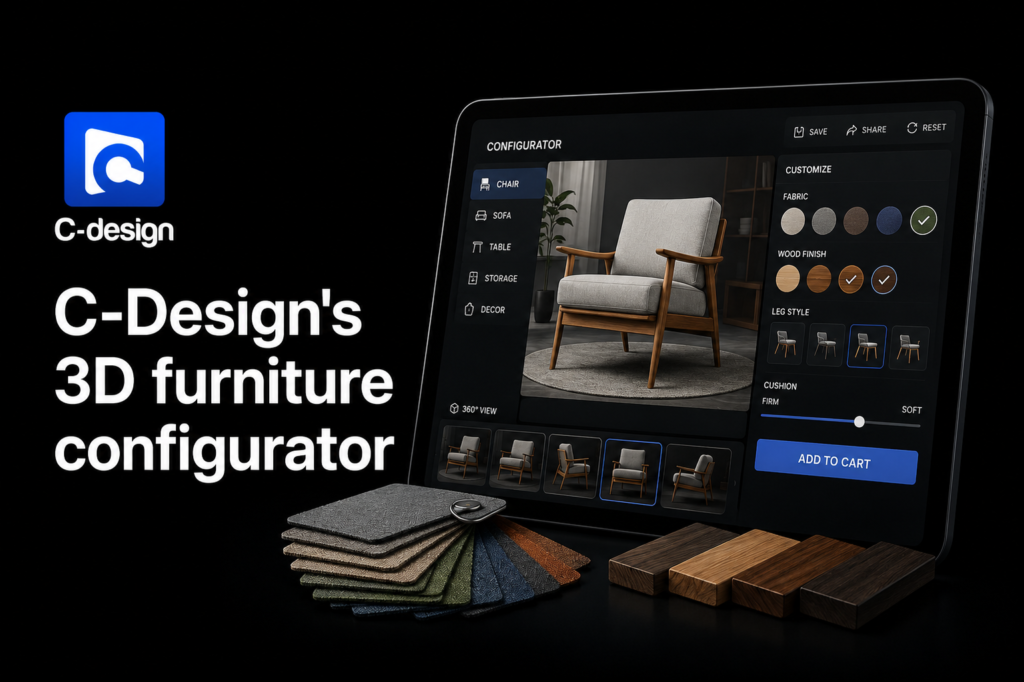
For decades, furniture e-commerce lived and died by static photography. Brands invested heavily in physical prototypes, styled shoots, and catalog cycles that stretched across months. Shoppers were left squinting at thumbnail images, trying to imagine how a sectional would look in sage green instead of the displayed charcoal. The result was a persistent confidence gap that translated directly into abandoned carts and costly returns.
C-Design was built to close that gap. Since 2005, operating under the Outsource 3D Modeling banner, the studio’s proprietary pipeline converts a single master 3D asset into an unlimited library of photoreal, interactive product variants — all rendered live in the browser, without plugins and without compromise on visual fidelity.
The Problem with Static Catalogs
A mid-range sofa offered in ten fabrics, three leg finishes, and two configurations represents sixty distinct SKU combinations. Photographing every variant with studio-quality lighting can cost tens of thousands of dollars per product line — before re-shoots when materials change or new colorways emerge. Physical samples take weeks to produce, and by the time a catalog is live, suppliers have already updated fabric collections.
Beyond cost, there is the deeper problem of emotional distance. A flat photograph cannot let a shopper feel scale, explore texture, or visualize a piece inside their own home. That inability to truly connect with a product is the root cause of furniture’s historically high return rates — and the core problem that 3D configuration solves.
What the Configurator Does
C-Design’s configurator renders a photorealistic 3D product model Interactive 3D Furniture Configurator3D Furniture Modelingdynamically — recalculating lighting, shadow, reflection, and material appearance in real time as the user makes selections. Six core capabilities drive the experience:
• Fabric and finish swapping — switch materials instantly, with accurate texture tiling and sheen
• Material tint and reflection control — adjust hue and specular intensity from matte to high-gloss
• Functional animations — open drawers, extend tables, unfold sofa beds to verify real-world usability
• Multi-state products — toggle between compact, standard, and extended configurations
• 360-degree orbit — examine every angle, from floor-level detail to overhead perspective
All of this runs natively in the browser, on desktop and mobile, without a download or plugin. The experience feels as immediate as scrolling through social media — and far more informative than any static photograph.
The Asset Pipeline Behind the Experience
The configurator’s power lies in C-Design’s proprietary four-stage pipeline, refined over nearly two decades:
• Master model creation — geometrically accurate digital twins built from manufacturer drawings and physical samples, with topology optimized for both visual quality and animation performance.
• PBR material authoring — each material is defined by texture maps (albedo, roughness, metallic, normal, ambient occlusion) that describe realistic light interaction under any lighting condition.
• Optimization and rigging — models are LOD-optimized for mobile, and products with mechanical behavior are rigged with animation constraints that prevent impossible configurations.
• Real-time rendering integration — packaged for WebGL and WebGPU with Image-Based Lighting (IBL), producing reflections and material sheen that shoppers regularly mistake for photography.
Because models are built on modular, reusable asset structures, the marginal cost of adding products to a configured catalog decreases over time. Material libraries, lighting environments, and animation rigs are shared across product lines.

Business Impact
Adopting interactive 3D configuration is a strategic business decision with measurable ROI across three dimensions:
Reduced Sample Costs
Brands using C-Design’s configurator have reported 60–80% reductions in physical sample spend. Variants that previously required individual prototypes can now be explored digitally before any physical production is commissioned, eliminating manufacturing, shipping, and storage costs.
Faster Go-to-Market
Adding a new fabric option traditionally meant ordering a sample, scheduling a shoot, editing imagery, and pushing updates through a catalog system — a process taking weeks. With C-Design’s pipeline, a new material variant requires only a new PBR material set, deployable in days. Brands respond to trend shifts and supplier updates in near real-time.
Higher Conversion, Lower Returns
When shoppers can explore a product in depth — checking scale, examining texture, verifying that drawers open smoothly — they purchase with greater confidence. That confidence translates directly into fewer returns, fewer support contacts, and higher customer lifetime value.
Augmented Reality and Enterprise Scale
The same assets powering the browser configurator are built to AR-ready standards. Shoppers on mobile can place a configured sofa — in their chosen fabric, at their chosen size — into a live camera view of their own room. C-Design’s AR models are optimized for both ARKit and ARCore, ensuring consistent 60fps performance across iOS and Android on mid-range hardware.
For enterprise deployments, the configurator is built on a headless API architecture that integrates cleanly with Shopify, Salesforce Commerce Cloud, Magento, and custom commerce stacks. Configuration state data — chosen fabric, finish, and product state — passes back as structured SKU data, preserving existing fulfillment workflows. Catalog teams manage new materials and variants through a dedicated CMS without developer involvement.
The system is architected for environments where product counts number in the hundreds, seasonal updates happen quarterly, and performance consistency across global CDN deployments is non-negotiable.
The Future of Furniture Retail Is Configurative
Consumer expectations shaped by personalization engines in fashion, automotive, and electronics are rapidly migrating to home furnishings. Shoppers increasingly expect to design, not just discover — to see their choices rendered in real time before they commit.
Every configuration session generates behavioral data invisible inside a static catalog: which fabrics are explored most, which combinations are abandoned, which states are trialed before purchase. That intelligence feeds smarter product development, sharper merchandising, and more relevant marketing.
Static catalog shots only tell half the story. C-Design’s Interactive 3D Furniture Configurator tells the rest — in full color, at any angle, with every finish, in the customer’s own home.

Frequently Asked Questions
1. What types of furniture products work best with a 3D configurator?
The greatest impact is felt by products with high variant complexity — sofas with multiple upholstery options, extendable dining tables, bedroom storage with varied finishes, and modular shelving. Products that have historically required large numbers of physical samples, or that generate high return rates due to expectation mismatch, are the strongest candidates.
2. How long does it take to bring a new product into the configurator?
A straightforward upholstered chair with four fabric options can be modeled, rigged, and integrated within two to three weeks. A large multi-state product line with twenty or more material variants may take four to six weeks for initial deployment. Once the master model and material pipeline are established, adding new variants is significantly faster.
3. Does the configurator work on mobile devices?
Yes. All models undergo a dedicated mobile optimization pass including LOD generation and texture compression. The configurator is tested across iOS and Android devices, including mid-range hardware, to ensure smooth frame rates. The AR extension is fully compatible with ARKit on iOS and ARCore on Android.
4. Can it integrate with our existing e-commerce platform?
Yes. The headless API architecture is compatible with Shopify, Salesforce Commerce Cloud, Magento, and custom-built stacks. Configuration state data passes back as structured SKU data that connects cleanly to existing cart and fulfillment workflows. C-Design’s technical team provides platform-specific integration documentation and support.
5. How does visual quality compare to traditional photography?
C-Design’s models use PBR materials and Image-Based Lighting — the same techniques used in visual effects production. In side-by-side comparisons, rendered outputs are regularly indistinguishable from studio photography among non-specialist audiences. The interactive nature of the experience generally provides greater shopper value than a static image at equivalent visual quality.
6. What information does C-Design need to begin a project?
The team works best with technical drawings or CAD files, physical material samples or high-resolution scans for each variant, reference photography from multiple angles, and a specification of which product states need to be represented. Where drawings are unavailable, detailed photographs and physical samples can substitute. A pre-project discovery call is included in all engagements to align on deliverables and timelines.
Ready to transform your furniture catalog?
Visit www.outsource3dmodeling.com to explore C-Design’s 3D modeling services.