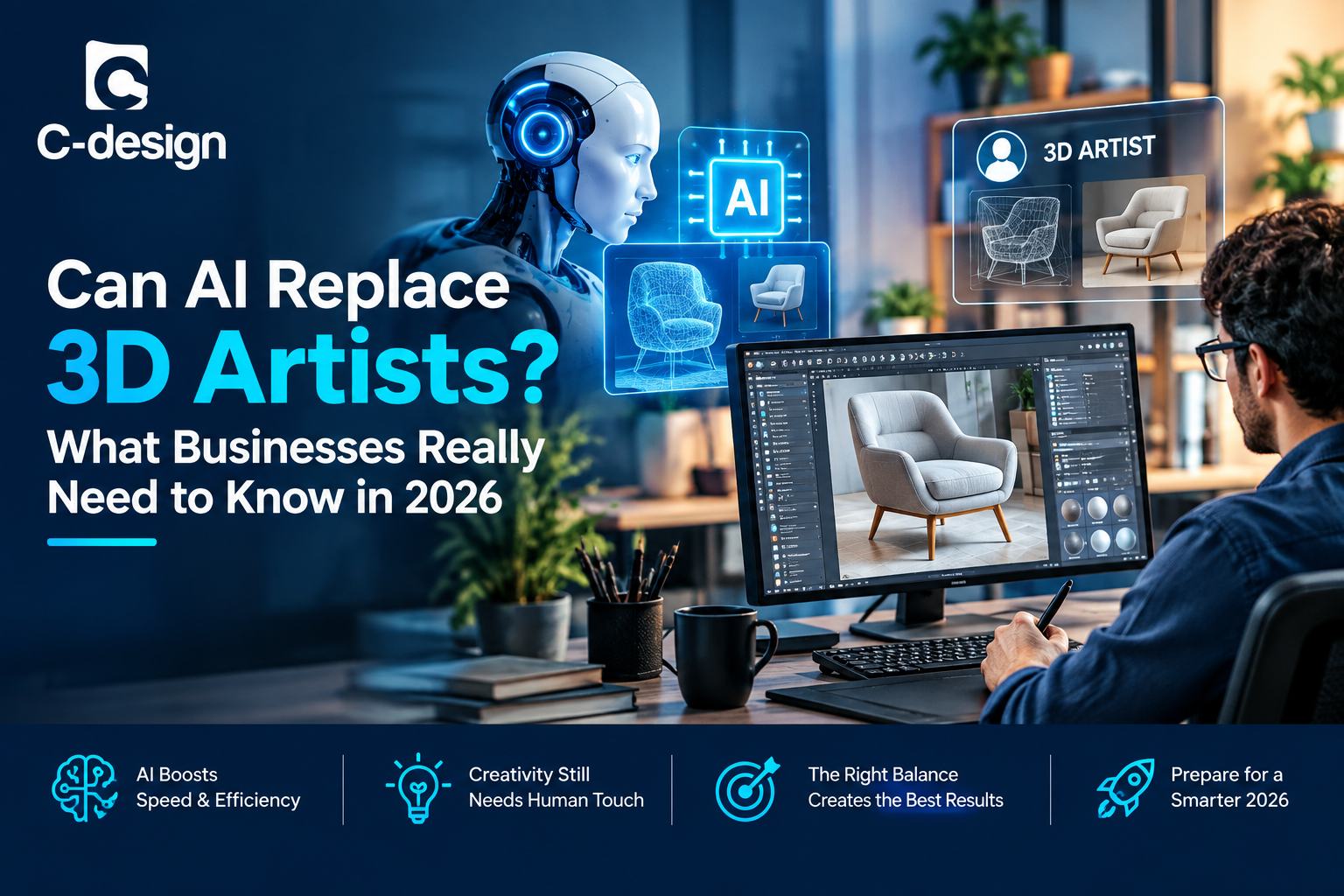
Artificial intelligence is changing 3D production faster than many businesses expected. Text-to-3D, image-to-3D, automatic texturing, and AI-assisted rendering tools can now create a first-pass 3D asset in minutes. For companies that need product visuals, e-commerce assets, AR experiences, marketing renders, or digital prototypes, this development raises a practical question: can AI replace professional 3D modelers?
The short answer is no—not for most business-critical work in 2026. AI is becoming a powerful production assistant, but it is not a complete replacement for experienced 3D artists, CAD modelers, and technical visualization specialists. AI can accelerate ideation and routine asset creation. Human professionals are still needed to ensure accuracy, clean topology, material realism, brand consistency, editability, and production-ready delivery.
For companies that want the speed of AI without the risk of unfinished or inaccurate assets, Outsource 3D Modeling provides a practical human-plus-AI workflow. The team can use modern AI tools where they create value, then apply professional modeling, cleanup, optimization, and quality control before final delivery.

Why businesses are asking
Businesses are under constant pressure to create more visual content. Online stores need 3D product views, marketers need high-quality renders, manufacturers need digital prototypes, and brands increasingly want assets that work across web, AR, VR, social media, and configurators.
Traditional 3D modeling can take time, particularly for complex products, large catalogs, or highly detailed scenes. AI promises a faster route from an image or prompt to a usable 3D model. That promise is attractive, especially for businesses trying to reduce production costs and launch products faster.
But a quick model is not always a usable model. A 3D asset that looks acceptable in a single preview may fail when it is rotated, animated, sent to a game engine, used in AR, or checked against a technical drawing. Businesses need to understand the difference between AI-generated starting points and professional-grade deliverables.
What AI 3D modeling does well
AI 3D tools are improving quickly. In 2026, they can help generate broad shapes, simple props, basic product concepts, early visualizations, and rough meshes from images or text prompts. They are especially useful when speed matters more than precision.
AI can help with:
- Early product concept exploration
- Fast image-to-3D or text-to-3D starting points
- Simple background props and generic objects
- Initial texture or material suggestions
- Quick variations for internal discussions
- Rough blockouts for scenes and environments
- Draft assets for marketing concepts
For early ideation, AI can be extremely useful. It allows teams to explore more directions before investing in detailed manual modeling. It can also reduce repetitive setup work and help 3D artists begin from a rough base rather than a blank scene.
Where AI still falls short
AI-generated models can look impressive at first glance, but professional production requires more than a convincing preview. Current AI outputs often have problems with geometry, dimensions, detail consistency, and editing control.
Common limitations include:
- Incorrect or approximate dimensions
- Missing geometry on unseen sides of a product
- Non-manifold edges, overlapping faces, and floating elements
- Dense triangle meshes with poor edge flow
- Inconsistent UV mapping and textures
- Weak reproduction of logos, labels, text, and branded details
- Difficulty maintaining consistent variants across a product catalog
- Limited control over exact materials, hardware, and assembly logic
These issues are particularly important for e-commerce, AR/VR, manufacturing, animation, and product visualization. A model may look good in a static AI preview but still be too heavy for a website, too inaccurate for a product viewer, or too poorly structured for animation.
Recent 2026 industry analysis notes that AI 3D models frequently need engineering review before manufacturing because they often lack tolerances, material specifications, and design-for-manufacturing considerations. AI-produced meshes may also contain non-manifold geometry, inconsistent edge flow, or unoptimized topology.rapiddirect+3
Why professional modelers matter
Professional 3D modelers do more than create shapes. They interpret references, understand product construction, make technical decisions, solve visual problems, and build assets for a specific purpose.
A professional modeler can:
- Model exact dimensions from CAD files, drawings, or product samples
- Create clean, editable topology suitable for animation or real-time use
- Build optimized models for web, AR, VR, games, or rendering
- Match materials, finishes, labels, colors, and brand standards
- Create accurate product variations, assemblies, and configurations
- Fix technical issues before they become expensive downstream problems
- Deliver assets in the formats and specifications required by the client
This work requires judgment. A human modeler can identify when a reflection looks unrealistic, when a material does not match the real product, or when an assembly is logically incorrect. AI does not reliably understand the commercial, engineering, and brand context behind those decisions.
AI vs professional modeling
| Factor | AI 3D Modeling | Professional 3D Modeling |
|---|---|---|
| Speed | Very fast for first drafts | Takes longer, especially for complex assets |
| Accuracy | Often approximate | Can match CAD, drawings, and physical references |
| Topology | Frequently needs cleanup | Built cleanly for the intended use |
| Brand consistency | Limited and unpredictable | Controlled across products and variants |
| Technical usability | May fail in AR, animation, or manufacturing | Optimized for specific delivery channels |
| Revisions | Can regenerate but may change unintended details | Controlled edits with predictable results |
| Best use | Concepts, rough props, early exploration | Production assets, e-commerce, AR, animation, and technical work |
The comparison shows why AI is best viewed as an accelerator. It can reduce time spent on early steps, but it does not remove the need for professional validation and refinement.
The best choice: human plus AI
For most businesses, the best choice is not AI-only or human-only. It is a hybrid workflow.
In a human-plus-AI workflow, AI can generate an initial concept, reference mesh, or rough asset. A professional 3D modeler then reviews the output, corrects geometry, rebuilds weak areas, creates clean topology, applies accurate materials, and optimizes the file for the intended platform.
This approach delivers several benefits:
- Faster concept development
- Lower production time for suitable asset types
- Better quality control
- Accurate and editable final models
- Consistent materials and branding
- More reliable files for web, AR, animation, and rendering
The result is not simply a faster model. It is a usable business asset.
When AI-only can be enough
AI-only workflows can be useful when the output is low-risk and speed is more important than precision. Examples include:
- Internal brainstorming and concept exploration
- Quick mockups for nontechnical presentations
- Generic background objects
- Temporary placeholders in a layout or scene
- Early tests of style, color, or composition
- Low-detail social-media visuals where products do not need exact accuracy
Even in these cases, businesses should review outputs for errors, copyright concerns, and brand misalignment before publication.
When professional modeling is essential
Professional 3D modeling is the safer and more effective choice when a model will be used for customer-facing, interactive, technical, or high-value work.
Professional help is essential for:
- E-commerce product models and 360-degree viewers
- AR/VR-ready product assets
- Configurators with multiple colors, sizes, and components
- Manufacturing, engineering, or prototype workflows
- High-end product renders and advertising campaigns
- Complex machinery, electronics, furniture, or medical products
- Animation-ready characters and assets
- Large catalogs that require consistent naming, scale, material logic, and quality
In these applications, small model errors can create major commercial problems. For example, an inaccurate e-commerce model can misrepresent a product, while unoptimized geometry can slow a website or break an AR experience.
How Outsource 3D Modeling helps
Outsource 3D Modeling helps businesses make practical use of AI without relying on it blindly. The company combines skilled 3D professionals with AI-assisted techniques to deliver assets that are accurate, optimized, and ready for real business use.
The workflow can include:
- Reviewing product photos, CAD files, drawings, and reference material
- Using AI tools for early ideation or accelerated base generation where appropriate
- Manually modeling or rebuilding geometry to achieve the required accuracy
- Creating clean topology, UVs, materials, and textures
- Optimizing files for e-commerce, AR, VR, rendering, animation, or other platforms
- Conducting quality checks for dimensions, surfaces, textures, naming, and export formats
- Managing revisions and product variants with controlled changes
This gives businesses the efficiency advantages of AI while preserving the professional control needed for brand-critical work.
Benefits of outsourcing professional 3D work
Working with an outsourcing partner can help companies access the right skills without building a large in-house 3D department.
Key benefits include:
- Flexible capacity: Scale up for product launches, campaigns, or large catalogs
- Specialized talent: Access modelers, texture artists, render specialists, and technical 3D experts
- Cost control: Pay for the output and capacity needed rather than permanent overhead for every role
- Faster delivery: Use established workflows and dedicated production resources
- Quality assurance: Receive assets that are reviewed for accuracy and platform readiness
- Format flexibility: Get the correct deliverables for web, AR, VR, animation, rendering, or engineering use
- Confidentiality: Use NDAs and secure workflows when sharing product information or CAD data
For many businesses, outsourcing provides a practical way to use advanced 3D capabilities without carrying the cost of a full internal production studio.
A simple decision framework
Before deciding between AI and professional modeling, ask these questions:
- Does the model need exact dimensions or technical accuracy?
- Will customers see, rotate, configure, or interact with the asset?
- Does it need clean topology, optimized performance, or animation-ready structure?
- Is the product branded, regulated, complex, or high value?
- Do you need many consistent variants or a large catalog?
- Will the model be reused across multiple channels?
- Is a rough concept enough, or does the asset need to be production-ready?
If the answers involve accuracy, customer experience, reuse, or technical reliability, professional human review should be part of the workflow.
The future of 3D modeling
AI will continue to improve. It will speed up reference generation, automate repetitive tasks, help with asset variations, and make 3D creation more accessible. Some lower-complexity work will become faster and less expensive.
But the demand for high-quality professional modeling will not disappear. In fact, as more businesses adopt 3D for e-commerce, AR, digital twins, and interactive product experiences, the need for accurate, optimized, brand-consistent assets will increase.
The future is not AI replacing 3D modelers. It is AI changing what professional modelers spend their time on. Instead of manually creating every rough shape, artists will spend more time on direction, precision, optimization, problem-solving, and quality control.
Businesses that adopt a balanced human-plus-AI workflow will be in the strongest position. They will move quickly while still protecting quality, brand credibility, and technical performance.
SEO keywords
Can AI replace professional 3D modelers, AI 3D modeling services, professional 3D modeling, AI vs human 3D modeling, outsource 3D modeling, AI-assisted 3D modeling, 3D product modeling services, 3D modeling for e-commerce, AR-ready 3D models, 3D topology cleanup, Outsource 3D Modeling, 3D asset optimization.
FAQs
1. Can AI replace professional 3D modelers in 2026?
AI can speed up concepting and create rough 3D starting points, but it cannot reliably replace professional modelers for accurate, optimized, branded, and production-ready assets.
2. What are the main limits of AI-generated 3D models?
Common limitations include inaccurate dimensions, poor topology, non-manifold geometry, incomplete hidden surfaces, inconsistent textures, and weak control over product variants and technical specifications.
3. Is AI 3D modeling good enough for e-commerce?
AI may be useful for rough previews, but e-commerce assets often need professional cleanup and validation to ensure accurate product details, optimized performance, reliable materials, and consistent variants.
4. When should a business use AI 3D modeling?
Use AI for early concept exploration, rough mockups, generic background props, or low-risk visual tests where exact geometry and production readiness are not required.
5. When should a business hire professional 3D modelers?
Hire professionals for e-commerce, AR/VR, product configurators, manufacturing, technical visualization, high-end marketing, animation-ready assets, and large product catalogs.
6. How does Outsource 3D Modeling use AI?
Outsource 3D Modeling can use AI to accelerate appropriate early-stage tasks, then relies on experienced professionals for modeling, cleanup, topology, texturing, optimization, quality checks, and delivery.
7. Is a human-plus-AI workflow cost-effective?
Yes. It can reduce time spent on suitable early-stage work while ensuring that final assets are accurate and usable, helping businesses avoid the cost of downstream fixes or poor-quality customer experiences.
Call to action
AI can help your business create 3D content faster, but professional expertise is what turns a rough AI output into a reliable, production-ready asset. Outsource 3D Modeling combines AI-assisted speed with skilled human modeling, cleanup, optimization, and quality control.
Whether you need e-commerce models, AR-ready assets, product renders, animations, or a scalable 3D catalog, our team can help. Visit Outsource 3D Modeling to request a free 3D modeling quote and build a workflow that balances speed, quality, and cost.
Tags
AI 3D modeling, professional 3D modelers, AI vs human 3D modeling, 3D product modeling, outsource 3D modeling, AI-assisted 3D modeling, e-commerce 3D models, AR-ready 3D models, 3D topology cleanup, 3D asset optimization, Outsource 3D Modeling, 3D modeling services.
Related Blogs
Art assets in different styles like 2D art for interactive applications, Games, and UI. We are having more than 15 years of experience