In 2026, 3D product modeling is no longer a luxury. It is a necessity for brands that want to showcase products online, support AR experiences, create marketing visuals, or prepare for manufacturing. But with so many service providers available, choosing the right 3D product modeling company can be overwhelming.
The wrong choice can lead to inaccurate models, missed deadlines, poor communication, and wasted budget. The right choice can accelerate your product launches, improve marketing quality, and reduce long-term costs. That is why having a clear buyer’s checklist is essential.
For businesses that want reliable, high-quality results, Outsource 3D Modeling offers a trusted solution. With years of experience in 3D product design, modeling accuracy, and large catalog handling, the company helps brands move from concept to production-ready assets with confidence.
This guide breaks down exactly what to look for when you outsource 3D modeling services, with a practical, 10-point buyer’s checklist you can use to evaluate any vendor — including us, Outsource3DModeling.com.
Why Choosing the Right 3D Modeling Partner Matters in 2026
The 3D content industry has matured fast. AI-assisted rendering, real-time engines, AR shopping on Instagram and Amazon, and virtual showrooms have turned 3D assets from a marketing extra into a core sales tool. At the same time, hundreds of freelancers and agencies now claim to offer “professional 3D modeling services,” making it harder than ever to separate real expertise from inflated portfolios.
Choosing poorly costs more than money. It costs time-to-market, brand credibility, and customer trust — especially when a product’s 3D model doesn’t match its real-world dimensions, materials, or colors. Below is the checklist we recommend every business run through before signing a contract.
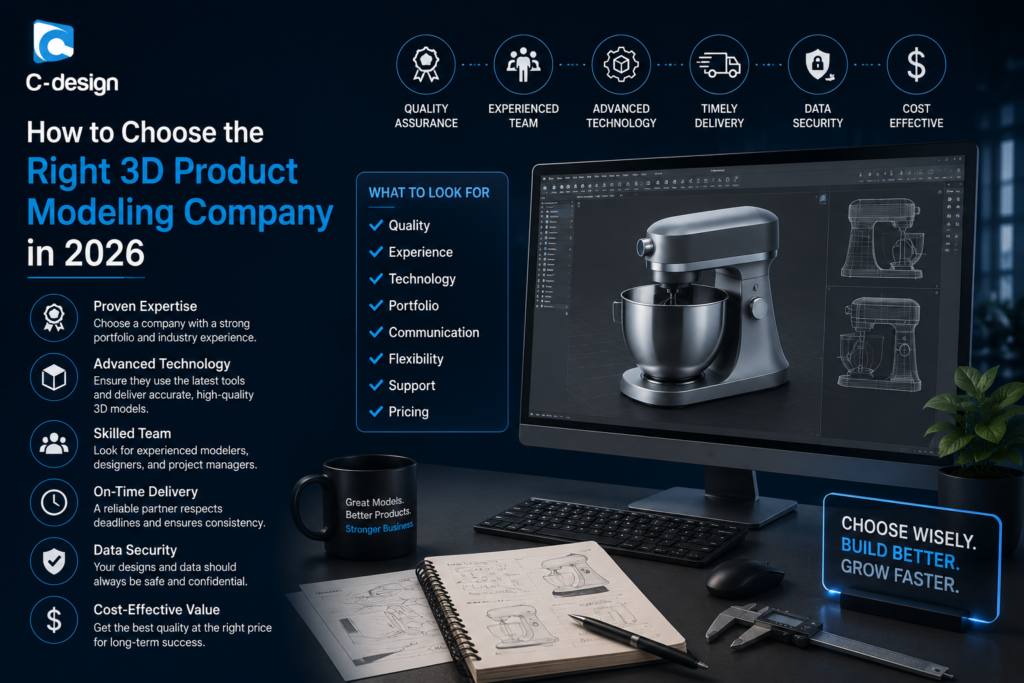
The 10-Point Buyer’s Checklist for Choosing a 3D Product Modeling Company
Use this checklist to score potential vendors objectively. A strong partner should check every box below — not just one or two.
1. Industry Experience
Experience is more than “years in business.” Ask potential vendors how many products they’ve modeled, which industries they specialize in, and whether they’ve handled projects similar in scale and complexity to yours. A company with deep experience in furniture 3D modeling, for example, will understand fabric draping, wood grain, and joinery details far better than a generalist studio.
- Ask: “How many SKUs have you modeled in my product category?”
- Ask: “Can you share client references or case studies?”
2. Portfolio & Niche Relevance
A strong portfolio tells you more than a sales pitch ever could. Look beyond polish — check for consistency across multiple products, accurate material rendering (glass, leather, metal, fabric), and evidence that the company can replicate your brand’s visual style at scale.
- Request samples specific to your product category, not just generic 3D art.
- Check if lighting, shadows, and material finishes look photorealistic across different lighting setups.
- Look for consistency — every product in a catalog should feel like it belongs to the same visual family.
3. Modeling Accuracy
Accuracy is where most low-cost vendors fail. A 3D product model must match the real product’s exact dimensions, proportions, textures, and colors — especially for e-commerce, where inaccurate visuals lead to returns and lost customer trust. Ask how the company verifies measurements: do they work from CAD files, technical drawings, spec sheets, or multi-angle reference photography?
- Confirm whether they can model from photographs alone or require CAD/technical references.
- Ask about their internal QA/QC process before final delivery.
- Request a test model or pilot SKU before committing to a full catalog.
4. Software Expertise
The right software stack affects both quality and compatibility with your existing pipeline. A capable 3D modeling company should be fluent across multiple tools and file formats so your models integrate smoothly into your website, AR platform, or rendering pipeline.
- Modeling: 3ds Max, Maya, Blender, ZBrush, SolidWorks, Rhino
- Rendering: V-Ray, KeyShot, Corona, Arnold
- File formats: OBJ, FBX, GLTF/GLB, USDZ, STEP, STL — critical for AR/VR and web viewers
5. Turnaround Time
Speed matters, but not at the cost of accuracy. Ask for a realistic per-SKU turnaround estimate and how that scales for bulk orders. A dependable partner will be upfront if a rush request compromises quality, rather than overpromising and under-delivering.
- Get turnaround estimates in writing, including for large batch orders.
- Ask how they handle urgent or rush requests, and whether that affects pricing.
6. Revision Policy
Even the best briefs need refinement. A transparent revision policy protects you from unexpected costs later. Look for a clearly stated number of included revision rounds, a simple feedback process, and reasonable turnaround for revised files.
- How many revision rounds are included in the base price?
- What is the process for submitting feedback (markup tools, calls, tickets)?
- Are revisions delivered within a guaranteed timeframe?
7. Confidentiality & Data Security
If you’re modeling unreleased products, prototypes, or proprietary designs, confidentiality is non-negotiable. A trustworthy 3D modeling company should offer a signed Non-Disclosure Agreement (NDA), secure file-sharing channels, and clear policies on data retention and deletion after project completion.
- Is an NDA offered and signed before any files are shared?
- How are source files, CAD data, and reference images stored and protected?
- What happens to your files after the project is completed?
8. Transparent Pricing
Pricing should be easy to understand and scale predictably. Watch out for vague quotes that don’t break down cost per SKU, complexity tier, or revision. The best vendors offer tiered pricing based on model complexity (low-poly vs. photorealistic) and volume discounts for large catalogs.
- Request an itemized quote broken down by SKU, complexity, and add-ons (animation, AR-ready formats, etc.).
- Ask about volume discounts for bulk or recurring catalog work.
- Confirm there are no hidden charges for file format conversions or revisions.
9. Communication
Time zones, language barriers, and unclear project management can derail even the most talented 3D team. Prioritize vendors who assign a dedicated project manager, provide regular status updates, and are responsive across your preferred communication channels — email, chat, or video calls.
- Is there a single point of contact for your account?
- What tools are used for project tracking and file sharing?
- How quickly do they typically respond to questions or issues?
10. Ability to Handle Large Product Catalogs
If you sell hundreds or thousands of SKUs, scalability is essential. Ask about the size of the production team, their capacity for parallel workflows, and how they maintain consistent quality and style across an entire catalog — not just a handful of hero products.
- Can they commit to recurring monthly or quarterly catalog updates?
- Do they use standardized templates or style guides to keep large catalogs visually consistent?
- What is their maximum monthly production capacity?
Why Outsourcing 3D Modeling Makes Sense
Outsourcing 3D product modeling offers several advantages:
- Cost efficiency: Pay only for what you need without hiring full-time staff.
- Access to expertise: Work with specialists who focus on 3D modeling daily.
- Scalability: Scale up or down based on project needs.
- Faster delivery: Dedicated teams can complete work faster.
- Focus on core business: Free internal teams to focus on strategy and growth.
These benefits make outsourcing a practical way to build a strong 3D asset library.
Common Use Cases
Brands use 3D product modeling for many purposes:
- E-commerce product pages and 360-degree views.
- AR and VR experiences for marketing and sales.
- Configurable product viewers on websites.
- Marketing renders and advertising visuals.
- Manufacturing and engineering documentation.
- Packaging and label design support.
In each case, having accurate, high-quality 3D models improves results and reduces costs.
The Future of 3D Product Modeling
The demand for 3D product assets will only continue to grow. As AR, VR, and interactive experiences become more common, brands will need more 3D content to stay competitive.
Companies that invest in 3D modeling now will be better positioned for:
- Immersive shopping experiences.
- Digital twins and product simulations.
- AI-driven visualization and automation.
- Global e-commerce expansion.
Choosing the right 3D modeling partner today is a strategic move for future growth.
Why Outsource3DModeling.com Checks Every Box
At Outsource3DModeling.com, we built our entire workflow around this exact checklist, because we know it’s how serious buyers evaluate 3D modeling partners. Here’s how we stack up:
- Proven Experience Across Industries: Our team has modeled products across furniture, jewelry, apparel, footwear, electronics, industrial equipment, and more — so we understand the nuances of your specific category.
- A Portfolio Built on Photorealism: Every project showcases accurate materials, lighting, and proportions, giving you confidence before you commit.
- Dimensional Accuracy, Guaranteed: We work from CAD files, spec sheets, or multi-angle photography and run every model through internal QA before delivery.
- Full-Stack Software Expertise: Our artists work fluently across 3ds Max, Maya, Blender, ZBrush, KeyShot, and V-Ray, delivering files in OBJ, FBX, GLTF/GLB, USDZ, and more for web, AR, and print.
- Fast, Reliable Turnaround: Clear timelines for single SKUs and bulk catalogs alike, with rush options when you need them.
- Fair, Transparent Revision Policy: Multiple included revision rounds with a simple feedback process, so you get it right without surprise fees.
- Strict Confidentiality: NDAs, secure file transfer, and strict data handling policies protect your unreleased and proprietary products.
- Transparent, Scalable Pricing: Itemized quotes and volume discounts designed for both single-product brands and large retailers.
- Responsive Communication: A dedicated project manager and regular updates keep you informed at every stage.
- Built for Large Catalogs: A scalable production pipeline capable of modeling hundreds to thousands of SKUs with consistent style and quality, on recurring schedules.
In short, we don’t just meet the checklist — we built our process around it, so brands and retailers can outsource 3D modeling with confidence instead of guesswork.
Ready to See the Difference the Right 3D Modeling Partner Makes?
Whether you need a single hero product or a catalog of 10,000 SKUs, our team is ready to help you launch stunning, accurate 3D models.
👉 Request a Free 3D Modeling Quote
Final Thoughts
Choosing the right 3D product modeling company in 2026 comes down to one thing: proof, not promises. Use the 10-point checklist above — experience, portfolio, accuracy, software expertise, turnaround, revisions, confidentiality, pricing, communication, and catalog scalability — to evaluate any vendor objectively before you sign a contract.
If you’re ready to work with a team that checks every box, Outsource3DModeling.com is ready to bring your products to life in stunning, accurate 3D.
👉 Request a Free 3D Modeling Quote Today
Frequently Asked Questions (FAQs)
1. How much does it cost to outsource 3D product modeling?
Pricing typically depends on model complexity, level of realism required, and order volume. Simple low-poly models cost less than photorealistic, animation-ready assets. Most 3D modeling companies, including ours, offer tiered pricing and volume discounts for large catalogs — always request an itemized quote before starting.
2. How long does it take to create a 3D product model?
A single, moderately detailed product model usually takes a few business days, while photorealistic or highly complex models can take longer. Bulk catalog projects are typically scheduled in batches with clear weekly or monthly delivery targets.
3. What files do I need to provide to get an accurate 3D model?
The more reference material you provide, the more accurate the result. Ideal inputs include CAD files or technical drawings, multi-angle photographs, material swatches, and exact measurements. If CAD isn’t available, an experienced studio can still model accurately from detailed photos and specs.
4. Can a 3D modeling company handle my entire product catalog, not just a few items?
Yes — established studios build scalable production pipelines specifically for large catalogs, using standardized style guides to keep hundreds or thousands of SKUs visually consistent. Ask any vendor directly about their maximum monthly production capacity before signing on.
5. Will my product designs stay confidential?
A reputable 3D modeling partner will sign an NDA before any files are shared and follow strict data protection practices, including secure transfer and controlled file retention. Always confirm confidentiality terms in writing before sending proprietary designs.
6. What file formats will I receive for my 3D models?
Common deliverables include OBJ, FBX, GLTF/GLB (for web and AR), USDZ (for iOS AR), and STL or STEP for manufacturing use cases. Confirm the formats you need upfront, especially if you’re integrating models into a specific e-commerce platform or AR tool.
7. How do I know if a 3D model is accurate before it goes live on my website?
Reliable vendors include a quality assurance step that checks proportions, dimensions, textures, and colors against reference materials before delivery. You should also request a pilot model or test SKU first to validate accuracy before committing to a full catalog.
Tags
Related Blogs
Art assets in different styles like 2D art for interactive applications, Games, and UI. We are having more than 15 years of experience