Introduction
Your next product collection needs realistic visuals. Your marketing team wants new campaign assets. Your existing catalog needs updates. As the requests grow, one question becomes difficult to ignore: should your business hire its own 3D artists or outsource the work?
The right answer is not simply the option with the lowest price. Your decision should reflect how often you need 3D assets, how specialized the work is, how quickly requirements change, and how much production management your team can handle.
For some businesses, in-house 3D modeling becomes a valuable long-term capability. For others, outsourced 3D modeling offers a practical way to access expertise and manage changing demand. Many companies can also benefit from combining the two.
This guide compares the options and gives you a practical framework for choosing a production strategy that supports your budget, projects, and business goals.
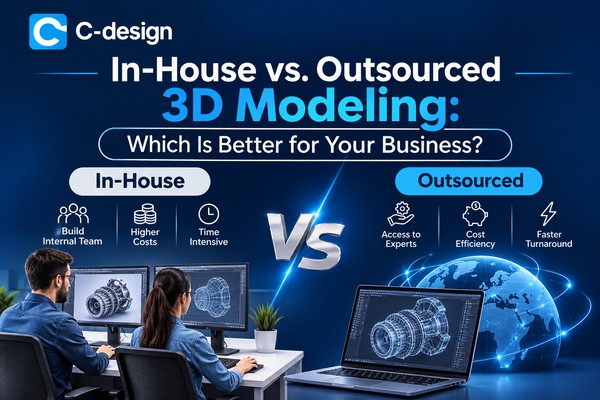
Start With Your Business Needs
Before comparing employees with external studios, define what your business needs to produce. “We need 3D modeling” is too broad to guide a useful investment decision.
A furniture retailer preparing lifestyle images has different requirements from a manufacturer explaining internal components. A marketing agency delivering occasional campaign visuals has a different workload from a business publishing new product assets every week.
Write down your product categories, expected asset volume, delivery channels, update frequency, and technical requirements. Also identify who will approve product accuracy and creative presentation.
This exercise helps you compare equivalent services. Otherwise, you may compare an internal team capable of the entire workflow with an external quote covering only basic geometry creation.
Understanding the Two Production Models
In-House 3D Modeling
In-house modeling means employing artists within your organization. They work under your management and use the tools, standards, and production systems your business provides.
This approach offers direct access to your team and opportunities to build product knowledge over time. It also requires an ongoing commitment to staffing, technology, training, and supervision.
An internal department is a capability you develop, not merely a salary expense. Its success depends on having enough suitable work and leadership to keep that capability productive.
Outsourced 3D Modeling
Outsourcing means assigning an agreed scope to an external specialist or studio. Your business supplies references, defines outputs, reviews progress, and accepts the completed work.
The arrangement might cover a single model, a product collection, recurring catalog updates, or a defined portion of a larger pipeline.
Outsourcing can introduce flexibility, but it does not remove your involvement. Clear instructions, timely decisions, and organized reviews remain essential.
The Main Differences
| Factor | In-house | Outsourced |
|---|---|---|
| Costs | Recurring staffing and infrastructure investment | Agreed external fees plus internal coordination |
| Speed | Direct communication; existing team capacity | Potential additional capacity; onboarding required |
| Scalability | Hiring, training, and internal scheduling | Adjustable scope, subject to supplier availability |
| Quality | Internal standards and accumulated knowledge | Defined benchmarks, pilots, and acceptance reviews |
| Resources | Manage staff, tools, and training | Manage briefs, feedback, and supplier coordination |
| Suitable demand | Continuous, specialized work | Defined assignments and fluctuating workloads |
Neither column represents an automatic advantage. The better option depends on how your actual work matches these characteristics.
Cost: Look Beyond the Quotation
The cost of in-house 3D modeling includes salaries, recruitment, benefits, workstations, software, storage, rendering resources, management, and training. Some expenses continue even when the production queue is quiet.
That can still be a sound investment when demand is consistent and the team’s expertise is strategically important. Repeated work may become more efficient as artists learn the product range and develop reusable systems.
Outsourcing changes the cost structure. Instead of funding every production resource directly, you pay for an agreed scope or capacity arrangement. However, coordination time, extra revisions, urgent requests, and additional deliverables can affect the final amount.
Compare total cost per approved asset rather than headline rates. Include your own review hours and the cost of correcting unsuitable files. A cheaper first draft is not a saving if it takes extensive effort to make usable.
Ask both internal managers and external providers to identify what their estimate includes. Modeling, materials, rendering, animation, and interactive optimization are not interchangeable services.
Speed: Identify the Real Bottleneck
An internal artist may resolve a product question quickly by speaking directly to an engineer or designer. This can be valuable when the work involves frequent experimentation or changing requirements.
But an internal team has limited capacity. If every artist is occupied, urgent requests create trade-offs between projects. Faster communication does not automatically mean faster overall delivery.
An external studio may help by taking on clearly scoped production while your internal team handles other priorities. That potential benefit depends on the provider’s availability and the readiness of your information.
Before choosing, identify where delays actually occur. Is the problem insufficient modeling time, slow approvals, missing dimensions, or repeated changes? Additional artists will not solve a decision-making bottleneck on their own.
Build a schedule that includes references, production, feedback, revisions, and final checks. Judge speed by the date assets are approved and usable, not simply when a preview arrives.
Scalability: Plan for Workload Changes
Your average monthly workload may look manageable while hiding significant seasonal peaks. A product launch can require several times the usual volume, followed by a quieter period.
Maintaining a permanent team sized for the busiest week may not suit that pattern. Outsourced 3D modeling can offer an alternative for defined peaks, provided capacity is agreed in advance.
If demand is steady throughout the year, internal staffing becomes easier to justify. Your artists can remain closely connected to recurring work and build specialized knowledge.
Do not interpret scalability as unlimited availability. Ask external teams how they allocate resources, manage simultaneous projects, and maintain review standards as volume grows.
A realistic capacity plan should cover normal demand, peak demand, and unexpected changes. Your business may need different production arrangements for each.
Quality: Use the Right Benchmark
The location of the artist does not determine quality. Skilled internal employees and capable external specialists can both produce excellent results when expectations are clear.
Start by defining what quality means for your project. A product image may require accurate materials and convincing lighting. An interactive model may also need controlled file size and suitable geometry. Technical visualization may place greater emphasis on component accuracy.
In-house teams can develop detailed knowledge of your products and preferences. However, a small department may not include every specialist skill your projects require.
An external provider may offer relevant experience in a specific category, but a polished portfolio is only the starting point. Ask whether the examples match your intended use, complexity, and delivery requirements.
Approve a representative pilot and test its files. An attractive image is not enough if the underlying asset cannot be used in your actual workflow.
Control: Separate Decisions From Production
Businesses sometimes assume that outsourcing means giving up control. A better distinction is between controlling decisions and personally managing every production action.
Your organization can retain ownership of product accuracy, brand direction, budgets, and final approval while assigning defined modeling tasks externally. The arrangement needs clear checkpoints and an agreed change process.
In-house production allows closer daily supervision, but it can also create constant interruptions or shifting priorities. Control is most useful when it produces clear decisions rather than endless revisions.
For either model, establish one current brief, a named project owner, and documented approvals. These simple measures reduce confusion more effectively than relying on informal conversations alone.
Resources: Consider Management Capacity
An internal department requires leadership. Someone must assign work, develop staff, maintain tools, plan leave coverage, and protect production time from conflicting requests.
Outsourcing transfers some of those responsibilities to the provider, but your team still needs to brief and review the assignment. External work becomes difficult to manage when nobody has authority to answer questions.
Consider the effect on your most expensive internal resources. If senior designers spend hours correcting unclear instructions, the problem may be the handoff rather than the modeling itself.
Reserve time for reviews in advance. A production plan is incomplete if artists can deliver work but nobody is available to approve it.
Confidentiality and Ownership Matter
Both internal and external production need sensible information controls. An internal team does not eliminate security risks, and outsourcing does not automatically make a project unsuitable for confidential work.
Before sharing unreleased designs, agree on confidentiality, access permissions, storage, subcontracting, and file-retention requirements. Use the organization’s approved transfer methods.
Ownership also deserves specific discussion. Confirm whether the agreement includes editable models, textures, final renders, reusable elements, and modification rights.
Clarify restrictions on third-party components or materials. These questions are easier to resolve before production than after your marketing team discovers it cannot update an important asset.
When In-House Is the Better Fit
An internal team deserves strong consideration when 3D work is continuous and closely connected to your core business.
It may suit your business when:
- You have a reliable workload for the required roles.
- Projects need frequent conversations with internal specialists.
- Product knowledge takes substantial time to develop.
- Your production tools require deep internal integration.
- You can invest in leadership and professional development.
Avoid hiring only because one project is urgent. Consider what the team will produce after that project ends and whether the long-term workload supports the commitment.
When Outsourcing Is the Better Fit
Outsourcing is worth exploring when your needs are defined but variable, or when a project requires expertise you do not use continuously.
It may suit your business when:
- Seasonal launches create short-term production peaks.
- Internal artists need help with approved production tasks.
- You want to test a new visual content format.
- Specialist work does not justify a permanent position.
- Clear references and timely reviews are available.
The strongest outsourcing assignments begin with a ready brief. If key product details remain unresolved, separate those decisions from production before releasing a large batch.
A Hybrid Model Can Bridge Gaps
You do not have to choose a single method for every project. A hybrid 3D production workflow retains selected responsibilities internally while assigning others to an external team.
For example, an internal creative lead might establish the visual style, approve the first model, and manage product accuracy. External artists might then produce agreed variants or related assets using that benchmark.
This can preserve business knowledge while adding capacity. It also creates a clear division between creative direction and repeatable production.
However, hybrid workflows need disciplined file management. Decide who edits each asset, which version is current, and how changes are approved. Without those rules, two teams may duplicate work instead of increasing output.
An Illustrative Product Launch
Imagine a consumer brand preparing a collection with several shared components and multiple approved finishes. Its internal team understands the products but already supports everyday campaigns.
The brand compares permanent hiring with outsourcing and a hybrid approach. It chooses a small pilot before committing to the wider production scope.
The internal team approves geometry and appearance. An external production team then prepares defined assets in batches, with feedback consolidated through one contact.
This is a hypothetical workflow, not a customer case study. Its purpose is to show how workload, repeatability, and review capacity can inform the decision without assuming guaranteed savings or faster delivery.
How Outsource 3D Modeling Fits In
For businesses evaluating external support, the useful next step is to connect those capabilities with a specific requirement. A furniture brand might prioritize finishes and proportions, while a manufacturer might emphasize component accuracy.
A marketing agency may need coordinated visual outputs for several channels. A company exploring interactive experiences should clarify performance and platform requirements separately from static image production.
Discuss relevant examples, available capacity, project communication, and a representative pilot. These conversations help establish whether the proposed service fits your business rather than assuming every provider suits every assignment.
A Practical Outsourcing Workflow
First, prepare the brief. Include product references, dimensions, materials, quantities, intended applications, required formats, and delivery dates. Flag information that may change.
Second, agree on a pilot. Select an asset that reflects the real complexity of the wider assignment. Review both the visible result and the usability of delivered files.
Third, establish production checkpoints. Approve geometry before detailed finishing where appropriate, consolidate feedback, and track questions through a shared log.
Finally, release work in batches and check acceptance carefully. Confirm naming, scale, textures, file formats, and any intended-platform requirements before adding the assets to your library.
Make the Decision With Evidence
Before committing to either model, compare a representative period of work. Record demand, accepted output, production time, internal review hours, and recurring problems.
For internal production, examine utilization and capability gaps. For external production, examine scope clarity, review effort, supplier reliability, and the cost of changes.
Use that evidence to decide whether to hire, outsource, or combine the approaches. Revisit the choice as your product range and content requirements evolve.
The best decision is not the one that wins an abstract debate. It is the one that consistently delivers usable assets with an acceptable balance of cost, quality, speed, and effort.
Build Capacity Without Losing Direction
Your business needs a 3D production strategy that fits the work ahead. That may mean investing in an internal team, partnering with external specialists, or connecting both through a clear workflow.
Visit www.outsource3dmodeling.com to discuss your project and request a tailored quote. Share a sample product, expected volume, required outputs, and target delivery date to begin a practical conversation.
Keep your creative direction. Find the right production support. Move from product references to purposeful 3D assets.
Frequently Asked Questions
1. Is outsourced 3D modeling always cheaper?
No. Compare total project costs, including briefing, revisions, internal reviews, and additional outputs. Outsourcing may suit variable demand, while consistent workloads may justify internal investment.
2. Which option offers better quality?
Either can produce strong results. Relevant skills, clear references, acceptance standards, and review discipline matter more than whether the artist is employed internally or externally.
3. Can outsourcing speed up production?
It can add capacity when the provider is available and the brief is ready. Include onboarding, approvals, and revisions when evaluating the proposed delivery schedule.
4. Should small businesses outsource?
A defined external project can be worth testing before hiring, especially with irregular demand. Start with a realistic scope and account for the time needed to review work.
5. Can we combine internal and external teams?
Yes. Retain product decisions and creative approval internally while assigning defined tasks externally. Agree on responsibilities, standards, file ownership, and revision procedures.
6. What should our agreement cover?
Include scope, formats, deadlines, revisions, confidentiality, ownership, source-file access, third-party restrictions, and acceptance criteria. Confirm responsibilities before sharing sensitive information or starting production.
7. How do we start with Outsource 3D Modeling?
Visit the website, provide your requirements, and request a scoped proposal. Discuss a representative pilot to assess output quality, communication, and compatibility before increasing production volume.
Tags
Related Blogs
Art assets in different styles like 2D art for interactive applications, Games, and UI. We are having more than 15 years of experience