Introduction
A large product launch is no longer only about manufacturing a great product. Today, brands must present that product convincingly across online stores, marketplaces, digital advertisements, social media, product catalogs, retail displays, sales presentations, and increasingly immersive AR and VR experiences.
For product manufacturers, e-commerce businesses, and global brands launching multiple products at once, this creates a major content challenge. Every product needs accurate 3D models, photorealistic renders, color and material variations, lifestyle scenes, technical visuals, packaging visuals, and campaign-ready assets. Producing all of this internally can overwhelm design teams, delay launches, and increase costs.
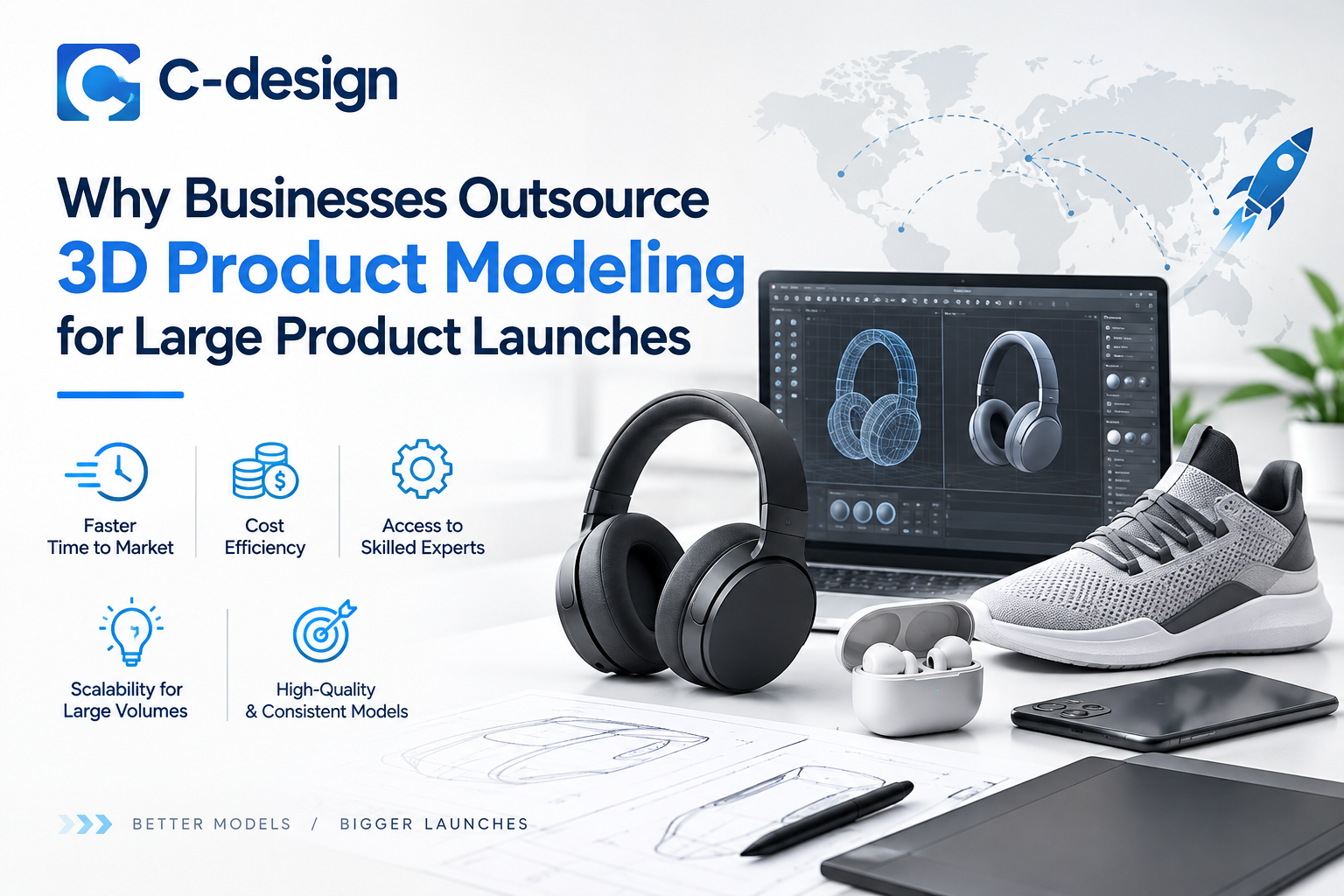
This is why many businesses choose to outsource 3D product modeling. A specialized 3D modeling partner can transform product concepts, CAD files, sketches, photographs, and technical specifications into realistic, reusable digital assets. The result is faster production, better visual quality, greater scalability, and a smoother launch process.
At Outsource 3D Modeling, C-Design helps businesses create high-quality 3D product models and visual assets for retail, manufacturing, e-commerce, furniture, electronics, consumer goods, and many other industries. With an internationally experienced team and structured production workflows, C-Design supports brands that need reliable 3D content at scale.
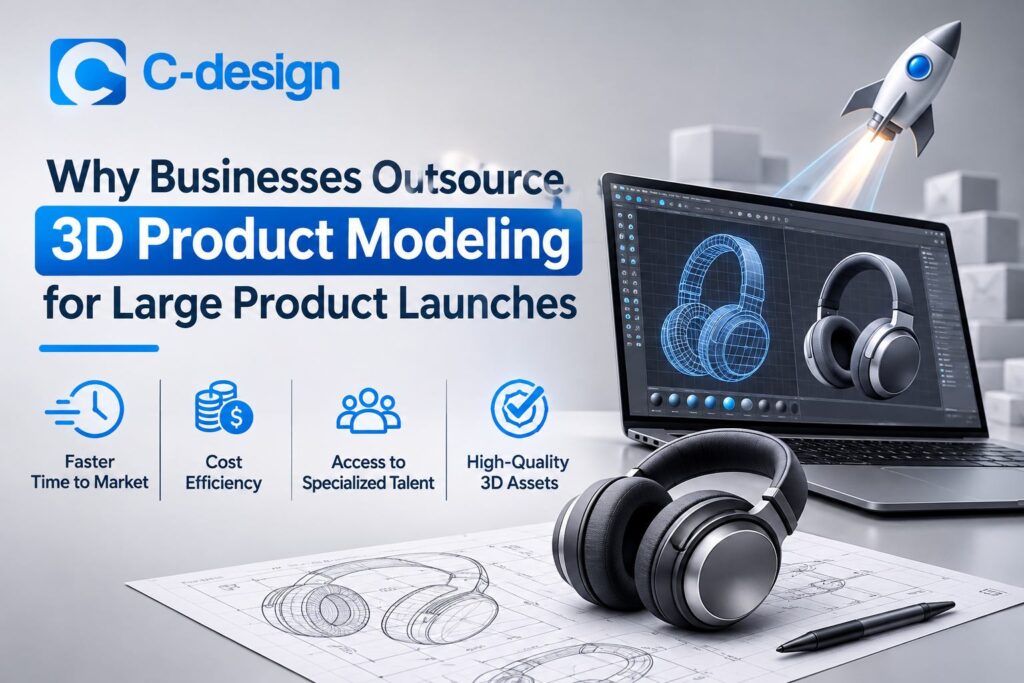
What Is Outsourced 3D Product Modeling?
Outsourced 3D product modeling is the process of assigning 3D modeling, texturing, rendering, and product visualization work to an external specialist team. Instead of hiring, training, and managing a large in-house 3D department, businesses partner with a company that already has the talent, software, hardware, workflows, and quality-control systems required for professional production.
A 3D product modeling partner can create:
- Photorealistic 3D product models for e-commerce listings and digital catalogs.
- High-resolution product renders for advertisements, websites, and social media.
- Color, material, texture, and configuration variations from one base model.
- Exploded views, technical illustrations, and assembly visuals.
- Product animations, turntables, and interactive 360-degree views.
- AR-ready and VR-ready 3D assets for immersive shopping experiences.
- Packaging, labeling, and retail display visualizations.
- Large volumes of catalog-ready models for multi-product launches.
The business supplies product references such as CAD files, technical drawings, photographs, dimensions, material details, brand guidelines, and launch deadlines. The outsourcing partner then converts those inputs into accurate, polished, and reusable 3D assets.
For businesses preparing large product launches, this approach removes a major production bottleneck. Instead of waiting for photography, physical samples, studio time, retouching, and repeated reshoots, teams can generate flexible digital visuals directly from accurate 3D models.
Why Large Product Launches Need 3D Product Visualization
Modern buyers expect to see products clearly before they purchase. They want to understand the shape, size, finish, features, materials, and real-life use of a product. This expectation is especially strong in e-commerce, where customers cannot physically touch or inspect an item before buying.
3D product visualization gives businesses a powerful way to meet this expectation. A realistic 3D model can show a product from every angle, highlight important details, demonstrate functionality, and present different versions without requiring a new physical photoshoot for every variation.
For example, a furniture brand launching a new chair collection may need images of every chair in multiple colors, fabrics, wood finishes, and room settings. With 3D product modeling, the brand can create one accurate base model and then produce consistent variations quickly. This is far more efficient than photographing every version separately.
The same advantage applies to electronics, appliances, cosmetics, packaging, industrial equipment, home décor, automotive accessories, toys, and consumer goods. A single high-quality 3D model can support product pages, advertisements, catalogs, sales decks, marketplace listings, email campaigns, and in-store displays.
The Content Challenge of Launching Multiple Products
Launching one product requires a significant amount of visual content. Launching ten, fifty, or hundreds of products simultaneously can become extremely complex.
Businesses often need to deliver:
- Product images for every SKU, color, size, and configuration.
- Consistent visuals across websites, marketplaces, and retail partners.
- Advertising creatives for paid social, display ads, and search campaigns.
- Catalog images with accurate proportions, colors, and product details.
- Lifestyle scenes that help customers imagine products in real environments.
- Technical visuals for manuals, sales teams, distributors, and B2B buyers.
- AR experiences that allow customers to preview products in their own space.
- Updated visuals whenever packaging, materials, features, or branding changes.
An internal team may be highly skilled, but it can only produce a limited number of assets within a fixed timeframe. When launch dates are tight, teams may be forced to prioritize certain products, reduce visual quality, delay listings, or outsource work at the last minute under pressure.
Outsourcing 3D product modeling gives businesses a practical way to expand production capacity without permanently expanding overhead. It allows internal teams to remain focused on strategy, branding, product development, marketing, and launch coordination while a specialist team handles high-volume 3D production.
Why Businesses Outsource 3D Product Modeling
1. Meet Tight Launch Deadlines
Product launches are deadline-driven. A delay in product visuals can delay marketplace listings, advertising campaigns, catalog printing, retailer approvals, and sales enablement materials.
Outsourcing helps businesses meet deadlines because specialized 3D teams are built for production. They can use parallel workflows, dedicated modelers, texture artists, rendering specialists, quality-control checks, and project managers to keep large volumes of work moving at the same time.
C-Design’s structured workflows, custom toolsets, and parallel production capacity are designed to help brands compress 3D asset timelines. Faster asset delivery supports faster product listings, faster campaign activation, and earlier revenue generation.
Instead of waiting for one internal artist to complete models one by one, businesses can assign batches of products to a team that can work simultaneously. This is especially valuable when a launch includes multiple product families, seasonal collections, regional variations, or frequent product updates.
2. Scale 3D Content Production Quickly
One of the biggest advantages of outsourcing is scalability. A business may need only a few product models during one quarter, then require hundreds of assets before a major seasonal launch.
Hiring enough in-house 3D artists to handle peak demand is expensive and inefficient. Once the launch is complete, those employees may not have enough work to justify their cost. Recruiting, training, software licensing, hardware upgrades, and management also add time and expense.
Outsourced 3D product modeling services allow businesses to scale production up or down based on actual demand. Whether a company needs 20 product models or 5,000, an established outsourcing partner can allocate the right resources without requiring the client to build a larger internal department.
This flexibility is particularly useful for e-commerce businesses with expanding catalogs, manufacturers introducing new product lines, and global brands managing launches across multiple markets.
3. Produce Realistic, High-Quality Product Visuals
Quality matters. A poorly modeled product can make even an excellent physical product look cheap, unclear, or untrustworthy. On the other hand, realistic 3D visuals can improve product understanding, strengthen brand perception, and help customers make confident purchase decisions.
Professional 3D product modeling includes accurate geometry, realistic materials, detailed textures, proper lighting, and high-quality rendering. The goal is not simply to create a digital version of a product; it is to create a visual asset that communicates the product’s value clearly and attractively.
C-Design provides 3D modeling services that include product modeling, texturing, digital sculpting, rendering, and virtual reality models. This range of capabilities helps businesses create visuals that are suitable for both technical communication and premium marketing campaigns.
High-quality 3D product visualization can show fine stitching on furniture, reflective surfaces on electronics, transparent materials in packaging, intricate mechanical components, fabric texture, metallic finishes, and subtle surface details. These details help products look credible and desirable across digital channels.
4. Reduce Workload for Internal Teams
When launch preparation is handled entirely in-house, designers, marketers, product managers, and engineers often carry too much responsibility. They may need to coordinate photography, manage revisions, prepare files for different platforms, check product accuracy, and respond to last-minute changes.
Outsourcing transfers the production burden to a dedicated partner. The internal team can provide direction, review deliverables, and approve final assets, while the outsourcing team manages modeling, texturing, rendering, revisions, file preparation, and production scheduling.
This reduces burnout and allows internal specialists to focus on higher-value work. Marketing teams can concentrate on campaign strategy and conversion optimization. Product teams can focus on innovation and quality. Sales teams can receive launch-ready visuals without waiting for internal design capacity.
In short, outsourcing does not replace internal expertise. It strengthens it by removing repetitive, time-consuming production tasks from the internal workflow.
5. Maintain Consistency Across Every Channel
Consistency is essential for a strong product launch. When a customer sees a product on a website, marketplace, social media advertisement, catalog, and retail display, the product should look recognizably the same every time.
Inconsistent colors, proportions, lighting, backgrounds, or product details can confuse customers and weaken trust. This problem becomes more common when different photographers, designers, or agencies produce visuals separately.
With 3D product modeling, businesses can create a single accurate digital source of truth for each product. From that model, teams can generate consistent renders for every channel. The same product geometry, materials, colors, and proportions can be reused across all assets.
This is especially important for global brands. A product launched in multiple countries may require different languages, packaging designs, promotional messages, and regional marketing formats. However, the core 3D product model remains consistent, making it easier to maintain a unified brand identity.
6. Lower Production Costs and Avoid Overhead
Building an internal 3D production team requires more than salaries. Businesses must invest in recruitment, training, high-performance computers, licensed software, rendering infrastructure, storage, project management, and ongoing technical support.
Outsourcing converts many of these fixed costs into a more flexible production cost. Businesses pay for the modeling and visualization work they need, without carrying the full expense of an in-house department throughout the year.
C-Design states that outsourcing can help businesses avoid recruitment costs, infrastructure investment, software licensing burdens, and long-term salary commitments. The company also highlights that clients can pay only for the work they need, while gaining access to specialized expertise and established production systems.
For businesses launching large product ranges, these savings can be substantial. The money saved on production overhead can be reinvested into advertising, packaging, retail expansion, product development, or customer experience.
7. Create More Assets From One 3D Model
Traditional product photography often requires a separate shoot for every color, angle, background, and variation. If a product changes, the entire photoshoot may need to be repeated.
3D product modeling works differently. Once a product has been accurately modeled, businesses can reuse it to create many assets without rebuilding the product from scratch.
From one 3D model, a brand can produce:
- Multiple camera angles and close-up detail shots.
- Different colorways, materials, finishes, and configurations.
- White-background images for e-commerce listings.
- Lifestyle renders for advertising and social media.
- Exploded views and technical illustrations.
- 360-degree product spins and animations.
- AR-ready models for virtual product placement.
- Updated visuals after design or packaging changes.
This makes 3D modeling a long-term content investment. The initial model continues to generate value across future campaigns, catalog updates, marketplace listings, and product revisions.
8. Support E-Commerce, Advertising, and AR Experiences
3D product models are not limited to static product images. They can support a complete digital commerce and marketing ecosystem.
For e-commerce, 3D models can improve product pages with consistent images, alternate views, zoomable details, and configuration options. For advertising, they can be used to create polished visuals for paid campaigns without arranging a new photoshoot for every creative concept.
For emerging shopping experiences, 3D models can support augmented reality. Customers may be able to place furniture in a room, view an appliance in their kitchen, or examine a product from different angles using their mobile device.
C-Design highlights its ability to create AR assets with detail and compatibility across devices and platforms. This can help brands offer more interactive and engaging product experiences, particularly in categories where size, fit, appearance, and placement matter greatly.
How Outsource 3D Modeling Works for Product Launches
A successful outsourcing partnership depends on a clear process. At Outsource 3D Modeling, C-Design follows a structured approach designed to make large-scale 3D product modeling efficient, accurate, and predictable.
Step 1: Share Product Information
The business provides product references, which may include CAD files, technical drawings, photographs, dimensions, material specifications, color references, branding guidelines, and examples of preferred visual styles.
Clear inputs help the 3D team understand the product’s geometry, proportions, materials, functionality, and intended use. The more complete the information, the faster and more accurate the modeling process will be.
Step 2: Define Asset Requirements
Before production begins, the client and outsourcing team agree on the deliverables. This may include the number of models, required views, rendering resolutions, background styles, file formats, color variations, animation needs, and delivery deadlines.
For a large launch, it is helpful to organize products into batches. This makes it easier to track progress, review samples early, and maintain consistent quality across the entire product range.
Step 3: 3D Modeling and Texturing
The 3D team creates accurate product geometry and applies materials, textures, colors, labels, and surface details. This stage turns technical references into a realistic digital representation of the product.
Professional modelers pay close attention to proportions, edges, curves, components, materials, and product details. This accuracy is essential for e-commerce listings, technical communication, and premium marketing visuals.
Step 4: Rendering and Quality Control
Once the model is complete, the team produces high-resolution renders using appropriate lighting, camera angles, and backgrounds. Quality-control checks help ensure that dimensions, colors, materials, labels, and visual details match the approved product information.
For large launches, quality control is not optional. A structured review process helps prevent errors from repeating across hundreds of assets.
Step 5: Revisions and Final Delivery
The client reviews the deliverables and provides feedback. The outsourcing team makes the required revisions and delivers final files in the formats needed for websites, marketplaces, advertising platforms, catalogs, and internal systems.
C-Design emphasizes dedicated project management, structured milestone delivery, and quick revisions. This type of process is particularly valuable when multiple stakeholders need to approve assets before a launch.
Industries That Benefit Most
Outsourced 3D product modeling is useful across many industries, but it is especially valuable for businesses with large catalogs, frequent product changes, or visually complex products.
- Furniture and home décor: Create multiple finishes, fabrics, configurations, and room scenes from one base model.
- Electronics and appliances: Show product details, interfaces, components, and technical features clearly.
- Consumer packaged goods: Visualize packaging, labels, product variations, and promotional displays.
- Industrial and manufacturing products: Produce technical visuals, exploded views, and sales-ready product presentations.
- Fashion accessories and footwear: Present materials, colors, shapes, and product details with consistency.
- Toys and games: Create engaging product visuals and packaging renders for retail and e-commerce.
- Automotive accessories: Visualize parts, finishes, installations, and compatibility.
- Health, beauty, and wellness: Create clean, premium visuals for packaging, bottles, devices, and product sets.
For each of these industries, 3D product modeling helps businesses communicate product value more effectively while reducing the time and cost associated with traditional visual production.
Why Choose Outsource 3D Modeling by C-Design?
Not every outsourcing partner offers the same level of capability, reliability, or production capacity. For large product launches, businesses need a partner that can deliver both creative quality and operational discipline.
C-Design, through Outsource 3D Modeling, offers businesses access to specialized 3D modeling expertise, advanced tools, proven workflows, and a globally experienced production team. The company has experience supporting clients across retail, real estate, manufacturing, and other industries.
Key advantages of working with C-Design include:
- Specialized 3D product modeling, texturing, rendering, and visualization services.
- Support for e-commerce product models, industrial prototypes, consumer goods, electronics, and mechanical product detailing.
- Ability to scale from a small set of models to high-volume catalog production.
- Structured workflows, dedicated project managers, milestone delivery, and revision support.
- Parallel production capacity that helps compress timelines for large launches.
- Photorealistic renders, product animations, AR-ready assets, and VR model creation.
- Cost-effective production without the overhead of building a large internal 3D department.
- Consistent visual quality across product catalogs, online stores, advertisements, and launch campaigns.
C-Design’s approach is designed to help businesses reduce design iterations, speed up approvals, communicate design intent clearly, and allow internal teams to focus on their core strengths. For a company preparing a major product launch, that combination of quality, speed, and scalability can make a meaningful difference.
Best Practices for a Successful Outsourced 3D Launch
To get the best results from outsourced 3D product modeling, businesses should treat the outsourcing partner as an extension of their launch team.
- Share complete and accurate product references, including CAD files, dimensions, materials, and branding guidelines.
- Create a clear asset checklist for every product, including required views, variations, formats, and deadlines.
- Approve a sample model or render early to establish quality expectations.
- Organize products into logical batches to simplify review and production tracking.
- Use a single point of contact for feedback to avoid conflicting instructions.
- Build time for revisions into the launch schedule.
- Request reusable source files where appropriate, so future updates can be made efficiently.
- Maintain a central asset library for models, renders, textures, and approved product visuals.
These practices reduce confusion, protect deadlines, and help ensure that every product asset supports the same high standard of quality.
Conclusion
Large product launches demand more than good products. They require a large volume of accurate, attractive, and consistent visual content across e-commerce platforms, digital advertisements, catalogs, sales materials, and immersive experiences.
Outsourcing 3D product modeling gives product manufacturers, e-commerce businesses, and global brands a practical way to meet these demands. It helps teams meet tight deadlines, scale production, reduce internal workload, create realistic product visuals, maintain consistency, and control costs.
Most importantly, it allows businesses to launch with confidence. Instead of being limited by internal production capacity, brands can deliver polished 3D assets for every product, variation, and marketing channel.
Outsource 3D Modeling by C-Design helps businesses turn product concepts into high-quality, launch-ready 3D assets. Whether you are launching a new product line, refreshing an e-commerce catalog, or preparing a multi-market campaign, C-Design can provide the specialized 3D production support needed to bring your products to life.
Call to Action
Ready to launch your products faster with high-quality, scalable 3D visuals?
Partner with Outsource 3D Modeling by C-Design for professional 3D product modeling, photorealistic rendering, e-commerce product visualization, and high-volume 3D asset production.
Visit www.outsource3dmodeling.com today to request a consultation, share your product requirements, and get a customized quote for your next large product launch.
Let C-Design help you create consistent, realistic, and conversion-ready 3D product assets—on time and at scale.
Frequently Asked Questions
1. Why do businesses outsource 3D product modeling for large launches?
Businesses outsource 3D product modeling to handle high volumes of visual content quickly, meet strict launch deadlines, reduce internal workload, maintain consistent quality, and avoid the cost of building a large in-house 3D team.
2. What types of 3D assets can an outsourcing partner create?
An outsourcing partner can create photorealistic product models, high-resolution renders, color and material variations, 360-degree views, product animations, exploded views, technical visuals, packaging visuals, and AR- or VR-ready assets.
3. Is outsourced 3D product modeling suitable for e-commerce businesses?
Yes. E-commerce businesses use 3D product modeling to create consistent product images, multiple product angles, variation visuals, lifestyle scenes, and interactive product experiences for websites, marketplaces, and digital advertisements.
4. How does outsourcing help businesses meet tight deadlines?
Specialized outsourcing teams use parallel production workflows, dedicated modelers, rendering specialists, quality-control processes, and project management. This allows businesses to produce many assets at the same time instead of relying on a limited internal team.
5. Can one 3D model be used for multiple product variations?
Yes. Once a base 3D product model is created, businesses can reuse it to produce different colors, materials, finishes, configurations, camera angles, backgrounds, and marketing visuals without rebuilding the model from scratch.
6. How does C-Design ensure quality across a large product catalog?
C-Design uses structured workflows, milestone-based delivery, quality-control checks, dedicated project management, and revision cycles. This helps maintain accuracy and visual consistency across large batches of product models and renders.
7. How can my business get started with Outsource 3D Modeling?
Visit www.outsource3dmodeling.com and share your product references, launch requirements, desired deliverables, and timeline. C-Design can review the project, recommend a production approach, and provide a customized quote.
Tags
Related Blogs
Art assets in different styles like 2D art for interactive applications, Games, and UI. We are having more than 15 years of experience