Launching several products at once is one of the most demanding moments for any product manufacturer, e-commerce business, or global brand. Marketing teams need product pages, advertisements, social-media creatives, catalog images, packaging visuals, marketplace listings, and campaign assets—often before the final physical sample is available.
This is where outsourcing 3D product modeling becomes a strategic advantage. Instead of relying only on photography, internal design teams, or rushed production schedules, businesses can partner with a specialist studio such as Outsource 3D Modeling to create accurate, photorealistic 3D product visuals at scale.
Outsourced 3D modeling helps companies meet tight deadlines, produce realistic product visuals, expand content production, reduce internal workload, and maintain consistent quality across every product catalog, online store, advertisement, and launch campaign.
What Is Outsourced 3D Product Modeling?
Outsourced 3D product modeling is the process of assigning 3D modeling, texturing, lighting, rendering, and product-visualization work to an external team of specialists. The client provides product references—such as CAD files, sketches, technical drawings, photographs, dimensions, material samples, or brand guidelines—and the outsourcing partner converts that information into high-quality digital product assets.
These assets can include photorealistic product renders, 360-degree spins, exploded views, lifestyle scenes, color and material variants, AR-ready models, e-commerce packshots, and animation-ready 3D models.
For a large product launch, outsourcing is not simply about getting a few images made. It is about building a reliable visual-production system that can support dozens, hundreds, or even thousands of SKUs while maintaining brand consistency and launch deadlines.
Why Large Product Launches Need 3D Product Modeling
A large launch involves far more than announcing a new product. Businesses must prepare visuals for websites, Amazon and other marketplaces, paid ads, email campaigns, retail catalogs, sales presentations, packaging, social media, and international marketplaces.
Traditional product photography can be effective, but it often depends on physical samples, studio availability, shipping schedules, reshoots, and manual retouching. When a company is launching multiple products simultaneously, those dependencies can quickly slow down the entire campaign.
3D product modeling removes many of these limitations. Once an accurate 3D model is created, teams can generate multiple camera angles, colorways, material options, backgrounds, and marketing visuals without repeatedly shipping products or rebuilding a studio set.
CGI product imagery can also be produced before a finished physical sample exists, provided the business has sufficient product information and material references. This makes 3D visualization especially valuable for pre-launch marketing, investor presentations, retailer negotiations, and early marketplace listings.
The Main Reasons Businesses Outsource 3D Product Modeling
1. To Meet Tight Launch Deadlines
Product launches usually follow fixed dates: a marketplace listing must go live, an advertisement must start running, a retail catalog must be printed, or a campaign must align with a seasonal sales period.
An in-house team may be capable of creating excellent 3D visuals, but it may not have enough artists, rendering capacity, or time to handle a sudden increase in workload. Outsourcing gives businesses access to a dedicated production team that can work in parallel on multiple products.
A professional 3D modeling partner can divide a large project into manageable stages: modeling, UV mapping, texturing, material creation, lighting, rendering, quality control, and final delivery. This structured workflow helps compress timelines and keeps launch assets moving even when internal teams are focused on product development, sales, or campaign strategy.
Outsource 3D Modeling uses organized workflows, custom toolsets, and parallel production capacity to help brands reduce 3D asset timelines and launch product listings and campaigns faster.
2. To Produce Realistic, High-Quality Product Visuals
Customers make decisions quickly online. They want to see the product clearly, understand its proportions, inspect details, and visualize how it will look in real life.
High-quality 3D product visualization allows shoppers to view products from every angle, zoom into details, and better understand size, materials, and features. This improved clarity can make customers more confident about what they are buying and help reduce uncertainty before delivery.
Outsourced 3D modeling teams specialize in creating realistic surfaces, accurate reflections, fabric behavior, metal finishes, glass transparency, wood grain, plastics, leather textures, and product-specific details. This expertise is difficult to build overnight inside a company that does not focus on 3D production every day.
For e-commerce businesses, realistic visuals are not just attractive—they support better product understanding. Online shoppers are more likely to buy when they have access to helpful media such as 3D models and 360-degree spin sets.
3. To Scale Content Production Across Many SKUs
A single product may need dozens of assets: hero images, white-background packshots, detail close-ups, lifestyle scenes, comparison images, feature callouts, social-media creatives, banner ads, and marketplace images.
When a company launches 10, 50, or 200 products at once, the volume of visual content becomes enormous. Hiring and training a large internal 3D team for a temporary launch period is expensive and inefficient.
Outsourcing allows businesses to scale production up or down based on demand. A company can assign five products one month and several hundred the next without carrying the fixed cost of a full-time internal 3D department.
This flexibility is one of the biggest advantages of 3D product modeling services. Businesses pay for the production capacity they need, while retaining the ability to expand quickly during peak launch periods.
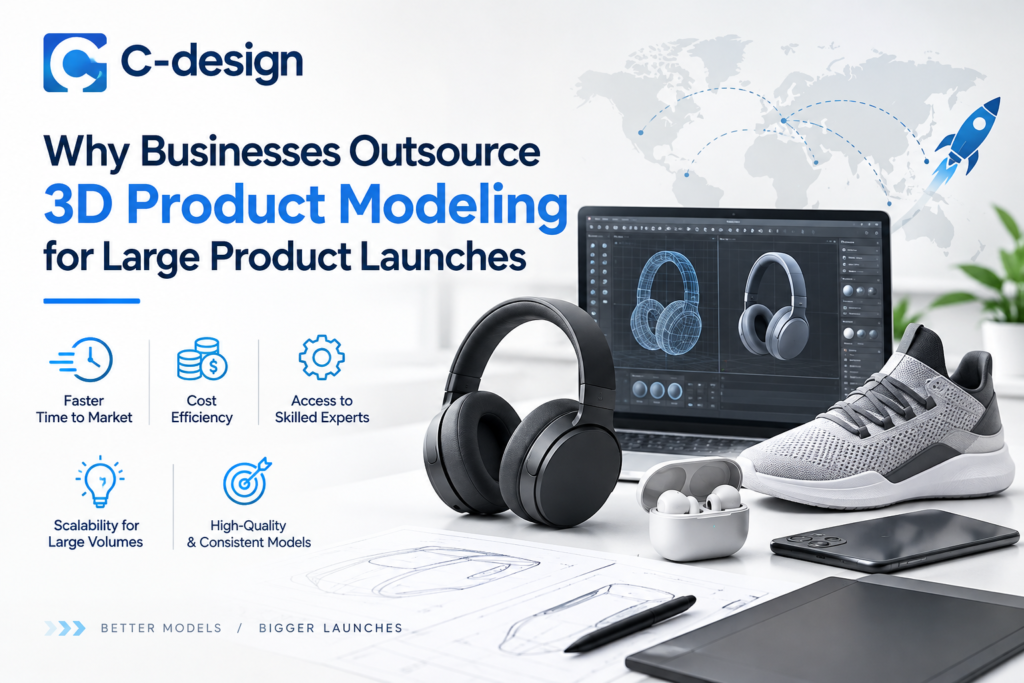
Outsourcing provides cost efficiency, specialist expertise, scalability, faster delivery, and the freedom for internal teams to focus on core business priorities.
4. To Reduce Workload for Internal Teams
Marketing, design, e-commerce, and product teams already have demanding responsibilities. Asking them to manage 3D modeling, revisions, file organization, rendering, quality checks, and asset delivery can pull attention away from higher-value work.
By outsourcing 3D product modeling, businesses can free internal teams to focus on strategy, branding, campaign planning, customer experience, merchandising, and sales.
A reliable outsourcing partner also reduces coordination pressure. Instead of managing multiple freelancers, software licenses, render farms, and inconsistent production standards, the business works with one accountable team.
This is particularly valuable for global brands that need to coordinate product information, approvals, deadlines, and asset delivery across different markets and departments.
5. To Maintain Consistency Across Product Catalogs
Consistency is essential for a professional brand. If one product has bright lighting, another has a different camera angle, and a third uses a different background, the catalog can look unorganized and reduce trust.
Outsourced 3D modeling makes it easier to apply the same lighting setup, camera perspective, background style, shadow treatment, color accuracy, and visual language across every SKU.
Once a master product template is approved, it can be reused for additional products and variants. This creates a polished catalog experience and makes it easier for shoppers to compare products.
For e-commerce businesses, consistent product presentation also improves the shopping experience. Customers can examine products in detail and compare options with confidence, which supports stronger engagement and conversion.
6. To Create More Assets From One 3D Model
One of the strongest financial benefits of 3D product modeling is reusability. After the initial model is created, it can be used to generate many visuals and variations.
A single 3D model can support:
- Multiple product angles and close-up renders
- Different colors, materials, patterns, and finishes
- White-background e-commerce images and lifestyle scenes
- 360-degree spins and interactive product viewers
- AR-ready models for mobile shopping experiences
- Animated product demonstrations and explainer videos
- Seasonal campaigns, promotional banners, and advertising creatives
This makes CGI especially cost-effective for businesses with many variants, frequent product updates, or large catalogs. While photography may be economical for a single existing product shot, CGI becomes more efficient when one model is reused across many angles, variants, and future campaigns.
For example, a furniture brand can model one chair and then quickly create renders in different fabrics, colors, and room settings. A consumer-electronics brand can use the same model for packaging visuals, website banners, marketplace listings, and product-demo animations.
7. To Support Omnichannel Product Launch Campaigns
Modern launches happen everywhere at once: brand websites, Amazon, Shopify stores, social media, paid ads, email, retail catalogs, marketplaces, and in-store displays.
Outsourced 3D modeling helps businesses create channel-ready assets from one central visual system. The same product model can be adapted for a clean e-commerce packshot, a bold social-media creative, a detailed catalog page, or an immersive advertising scene.
This reduces the need to recreate visuals for every channel. It also helps ensure that the product looks recognizable and premium wherever customers encounter it.
For global brands, this is especially important. A product launched in multiple countries needs visuals that can be localized, resized, and adapted without sacrificing quality or brand identity.
How Outsourcing 3D Product Modeling Works
A professional outsourcing process is simple, transparent, and designed to reduce the burden on the client.
Step 1: Share Product Information
The business provides product references such as CAD files, technical drawings, photographs, dimensions, material descriptions, color codes, packaging details, and brand guidelines. Even sketches or reference images can be useful at the start.
Step 2: Receive a Production Plan
The outsourcing team reviews the requirements and confirms the scope: number of products, required deliverables, rendering style, deadlines, revision process, and final file formats.
Step 3: 3D Modeling and Texturing
Specialists create accurate geometry, apply materials and textures, and ensure that the product reflects the intended design, proportions, and finish.
Step 4: Lighting, Rendering, and Post-Production
The team sets up studio or lifestyle lighting, renders the visuals, and performs retouching or post-production to achieve a polished, photorealistic result.
Step 5: Review, Revisions, and Delivery
The client reviews the drafts, shares feedback, and receives final assets in the required formats for websites, marketplaces, advertising platforms, catalogs, and 3D/AR applications.
This workflow allows product teams to stay involved at the right moments without managing every technical detail themselves.
Key Advantages of Outsourcing 3D Product Modeling
Faster Time to Market
Outsourced teams can begin work as soon as product information is available, even before final samples are ready. This helps businesses publish listings earlier, activate campaigns sooner, and capture demand at launch.
Lower Operational Burden
Businesses avoid the cost and complexity of recruiting, training, managing, and retaining a large specialized 3D team. They also reduce spending on software, hardware, render capacity, and ongoing production management.
Access to Specialist Talent
An outsourcing studio brings together modelers, texture artists, lighting specialists, rendering experts, and quality-control professionals. This breadth of skill is difficult to maintain in-house unless 3D production is a core part of the business.
Better Quality Control
Professional teams follow defined quality standards, review assets before delivery, and maintain version control. This reduces errors, inconsistent visuals, and time-consuming revisions.
Greater Flexibility
Launch needs change. Outsourcing lets businesses increase production during a major launch and reduce capacity afterward without long-term staffing commitments.
Stronger Brand Presentation
Photorealistic, consistent visuals make products look premium and trustworthy. This supports stronger first impressions across product pages, advertisements, and catalogs.
Why Outsource 3D Modeling Is Helpful for Product Launches
Outsource 3D Modeling helps businesses turn product information into launch-ready visual assets with speed, accuracy, and consistency. The company supports product manufacturers, e-commerce businesses, and global brands that need high-volume 3D product modeling without overloading internal teams.
Its approach is built around clear communication, structured production workflows, quality control, and scalable capacity. Clients can share CAD files, references, drawings, or product samples, and receive photorealistic 3D visuals tailored to their catalog, online store, advertising, and campaign requirements.
Outsource 3D Modeling can support:
- Photorealistic 3D product renders and CGI product images
- E-commerce packshots and white-background product visuals
- 360-degree product spins and interactive product visuals
- Color, material, and product-variant modeling
- Lifestyle scenes and customized marketing backgrounds
- AR-ready and web-optimized 3D models
- Product catalogs, marketplace listings, and advertising assets
- High-volume production for multi-product launches
The benefit is not only faster delivery. It is a dependable visual-production partner that helps businesses launch with confidence, maintain a premium brand image, and scale content production as the product range grows.
Global brands that use purpose-built outsourcing studios often report faster catalog launches, stronger asset consistency, and reduced per-unit production costs. Structured workflows and parallel production capacity can help compress 3D asset timelines from weeks to days, enabling faster product listings, campaign activation, and revenue generation.
3D Modeling Versus Traditional Product Photography
Both photography and 3D visualization have a place in a product-marketing strategy. The right choice depends on the product, launch scale, number of variants, and long-term content needs.
| Factor | Traditional Product Photography | Outsourced 3D Product Modeling |
|---|---|---|
| Physical sample | Usually required before shooting | Can begin with CAD files, drawings, or references |
| Variants | Often requires separate shoots | One model can create multiple color and material variants |
| Angles | Limited by the shoot setup | Many angles can be rendered from one model |
| Updates | May require reshoots | Model can be updated and re-rendered |
| Consistency | Depends on studio setup and retouching | Easier to standardize lighting, angles, and backgrounds |
| Best use case | Small catalogs or highly tactile products | Large catalogs, variants, launches, and scalable content |
For businesses launching multiple products simultaneously, 3D modeling often provides greater flexibility and long-term value because one accurate model can support many visual assets and future campaigns.
Industries That Benefit Most
Furniture and Home Décor
Furniture brands can show different fabrics, finishes, dimensions, and room settings without photographing every variation.
Consumer Electronics
Electronics companies can highlight ports, screens, materials, features, and product configurations with precise close-up visuals.
Fashion, Footwear, and Accessories
Brands can present colorways, materials, stitching, hardware, and product details while maintaining a consistent catalog style.
Beauty and Personal Care
CGI can create clean packaging visuals, ingredient-focused scenes, promotional banners, and premium product presentations.
Industrial Products and Machinery
Manufacturers can use exploded views, technical illustrations, component visuals, and detailed renders for catalogs, sales teams, and B2B buyers.
Toys, Sports, and Outdoor Gear
Brands can demonstrate product features, use cases, and variations across e-commerce listings and campaign visuals.
Best Practices for a Successful Outsourced 3D Modeling Project
- Provide complete product references, including CAD files, dimensions, materials, colors, and branding guidelines.
- Define the required deliverables early, such as render counts, image sizes, file formats, and marketplace specifications.
- Approve one master product visual before producing assets for every variant.
- Use a clear revision process with designated decision-makers.
- Create a reusable visual template for lighting, camera angles, backgrounds, and shadows.
- Plan for future variants by retaining source files and organized asset libraries.
- Start early enough to allow time for modeling, approvals, revisions, and final rendering.
Common Questions Businesses Ask
Many companies hesitate to outsource because they worry about quality, communication, intellectual property, or turnaround time. These concerns are valid, but they can be managed through a professional workflow, clear agreements, and an experienced partner.
A good outsourcing partner should provide clear timelines, regular updates, secure file handling, revision rounds, and final assets in the formats your team needs.
Frequently Asked Questions
1. Why should businesses outsource 3D product modeling instead of using an in-house team?
Outsourcing gives businesses immediate access to specialist talent and scalable production capacity without the cost of hiring a full-time internal 3D team. It is especially useful for large launches, seasonal catalogs, and businesses that need to produce many product visuals quickly.
2. Can 3D product models be created before the physical product is manufactured?
Yes. If a business provides CAD files, technical drawings, sketches, dimensions, material references, or detailed photographs, a 3D modeling team can create visuals before the final sample is available. This is useful for pre-launch marketing, retailer presentations, and early e-commerce listings.
3. How does outsourcing 3D modeling reduce product-launch workload?
The outsourcing partner handles technical production tasks such as modeling, texturing, lighting, rendering, revisions, and file delivery. This allows internal marketing, design, and e-commerce teams to focus on campaign strategy, sales, merchandising, and customer experience.
4. Are outsourced 3D product visuals suitable for Amazon and other marketplaces?
Yes. Professional 3D renders can be created in marketplace-friendly formats and sizes, including white-background product images, lifestyle visuals, feature graphics, comparison charts, and 360-degree spins.
5. Is 3D product modeling cost-effective for small businesses?
It can be. While a simple photography shoot may cost less for one basic product image, 3D modeling becomes more cost-effective when a business needs multiple angles, variants, future updates, or a growing catalog. One 3D model can generate many assets over time.
6. How long does it take to outsource 3D product modeling?
Timelines depend on product complexity, number of SKUs, level of detail, revision requirements, and final deliverables. A simple product may take only a few days, while a complex product or high-volume catalog may require a phased production schedule.
7. How do businesses protect product designs when outsourcing?
Businesses should work with a professional provider under a clear confidentiality or non-disclosure agreement. They should share only the necessary files, define ownership of final assets, and use secure file-transfer and version-control processes.
Final Thoughts
Large product launches demand speed, quality, consistency, and scale. Businesses that try to produce every visual internally often face delayed listings, inconsistent catalogs, overworked teams, and missed campaign opportunities.
Outsourcing 3D product modeling solves these challenges by giving brands access to specialist production capacity, photorealistic visuals, reusable 3D assets, and a structured launch workflow.
For product manufacturers, e-commerce businesses, and global brands launching multiple products at once, outsourcing is no longer just a cost-saving option. It is a growth strategy that helps teams launch faster, present products more convincingly, and scale visual content without sacrificing quality.
Call to Action
Ready to launch your next product range with premium, photorealistic 3D visuals?
Partner with Outsource 3D Modeling for scalable 3D product modeling, CGI product images, e-commerce visuals, 360-degree spins, and high-volume product-launch assets.
Visit www.outsource3dmodeling.com today to request a free quote, share your product references, and discover how our 3D product modeling services can help your business launch faster and sell with confidence.
Related Blogs
Art assets in different styles like 2D art for interactive applications, Games, and UI. We are having more than 15 years of experience