US and UK businesses need more 3D content than ever before. Product brands need accurate e-commerce models and photorealistic renders. Architecture and real estate firms need visualisations, walkthroughs, and BIM-ready assets. Manufacturers need digital product models, technical visuals, and assets for sales, training, and AR experiences. Marketing teams need a constant flow of images, animations, and interactive content.
The challenge is that high-quality 3D production can be expensive and difficult to scale in-house. Recruiting experienced artists takes time. Software, workstations, rendering capacity, training, and management add fixed costs. Workloads also fluctuate sharply: a firm may need a few models one month and hundreds of assets during a major launch, development, or campaign.
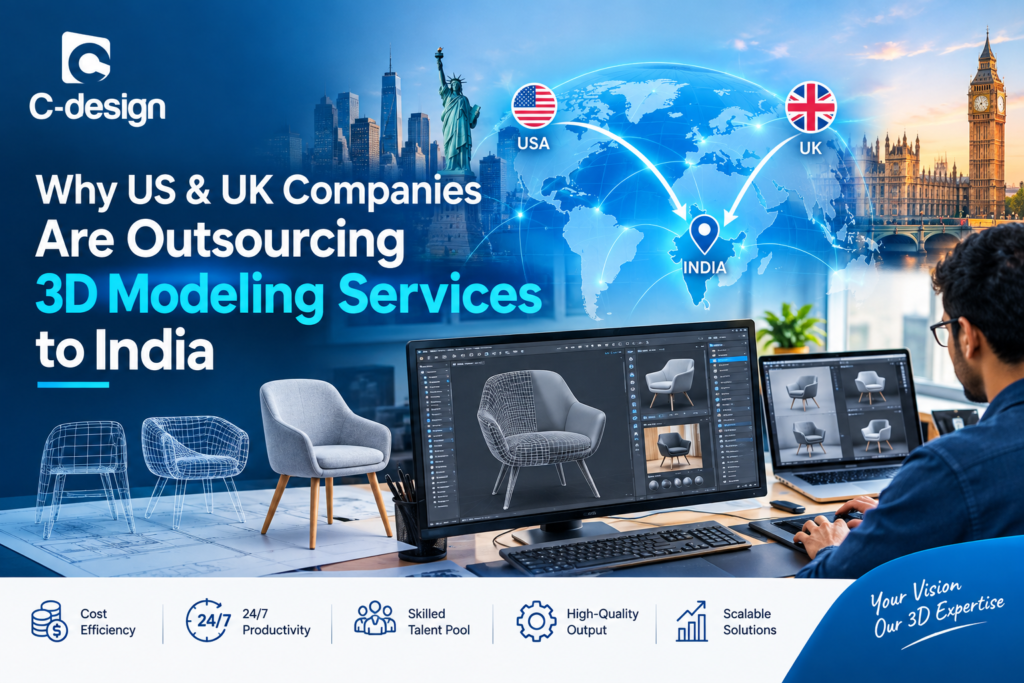
That is why many US and UK companies are outsourcing 3D modeling services to India. India offers a large talent base, established 3D production teams, competitive project costs, flexible capacity, and workflows designed to work with international clients. When managed properly, outsourcing helps companies improve turnaround, maintain quality, and focus internal teams on design direction, client relationships, marketing strategy, and growth.
Outsource 3D Modeling helps companies access this model through professional 3D modeling, rendering, visualisation, animation, AR/VR assets, and architectural support. The goal is not simply to reduce cost. It is to build a dependable, scalable 3D production workflow that delivers accurate assets for real business use.
Why 3D demand is growing
3D is no longer limited to entertainment or high-end design studios. It is now used across e-commerce, retail, architecture, real estate, manufacturing, healthcare, furniture, automotive, advertising, education, and industrial product development.
A single 3D model can be reused in many ways. A product model may support product renders, 360-degree web viewers, AR previews, interactive configurators, packaging concepts, animations, sales presentations, and training content. An architectural model can support design reviews, planning presentations, investor marketing, virtual tours, interior studies, and construction coordination.
This reuse makes 3D a valuable business asset. But it also means companies need well-built models. Assets must be accurate, efficient, consistent, editable, and suitable for their intended platform. That creates demand for skilled artists and technical 3D specialists.
Why India is a major outsourcing destination
India has developed a strong ecosystem for technology, engineering, design, animation, visualisation, and digital production. Many teams work with global clients and are familiar with international file formats, software, workflows, and quality expectations.
US and UK firms often choose India because it offers a combination of:
- Skilled 3D artists, modelers, visualisers, and animation professionals
- Competitive production costs compared with fully in-house or local studio models
- Flexible project and dedicated-team engagement options
- Experience with global software standards and delivery formats
- English-language communication and established project-management processes
- Time-zone differences that can support faster revision cycles
- Capacity for both individual assets and high-volume catalog work
The value is not based on geography alone. It depends on selecting an experienced partner with a disciplined workflow, clear communication, quality checks, and strong understanding of the client’s use case.
1. Reduce 3D production costs
Cost reduction is one of the most common reasons US and UK companies outsource 3D modeling to India. Running an internal 3D department requires much more than paying artist salaries. Businesses must also budget for recruitment, benefits, software subscriptions, high-performance workstations, rendering resources, training, management, and periods when the team does not have enough active work.
Outsourcing changes part of this fixed overhead into a flexible production cost. Companies can pay for the models, renders, or project capacity they need instead of maintaining a large permanent team for every possible workload scenario.
This can help companies:
- Avoid hiring full-time specialists for short-term projects
- Reduce recruitment and onboarding costs
- Limit overtime during product launches or campaign deadlines
- Avoid maintaining expensive hardware and rendering infrastructure
- Budget more accurately for a defined set of deliverables
- Scale resources up or down based on business need
Cost savings should not mean lower standards. The best outcome comes from pairing cost efficiency with clear specifications, professional quality control, and a partner that understands the final use of each asset.
2. Access skilled 3D artists
Professional 3D production includes multiple specialised skills. A product modeler may be excellent at accurate hard-surface work but not character animation. A texture artist may focus on materials and PBR workflows. A visualisation specialist may excel in lighting and photorealistic rendering. AR and real-time assets require optimisation, clean topology, UVs, and export knowledge.
Building all these skills internally can be difficult. Outsourcing allows US and UK companies to access specialists when needed rather than recruiting each role separately.
Indian 3D teams can support a wide range of disciplines, including:
- Product and industrial 3D modeling
- Furniture and retail catalog modeling
- Architectural and interior visualisation
- 3D rendering and animation
- Texturing, lighting, and material development
- AR/VR-ready assets and real-time optimisation
- CAD-to-3D conversion
- Technical illustrations and assembly animations
- Game art, environment modeling, and digital assets
This specialised access is particularly valuable for businesses that need different types of 3D work across the year.
3. Accelerate project delivery
Speed is a competitive advantage. A delayed product render can postpone an e-commerce launch. Slow visualisation can hold up a client presentation. An overloaded in-house team may struggle to respond to new campaign requirements or urgent product changes.
An outsourced 3D modeling partner can increase available production capacity and help keep projects moving. Established teams often have defined pipelines for modeling, texturing, rendering, revisions, and file delivery.
Time-zone differences can also support a more continuous workflow. A US or UK team can provide consolidated feedback at the end of its working day, while an India-based team begins revisions. The client can then review progress the next morning. This approach works best when both teams use clear briefs, reference materials, revision logs, and agreed deadlines.
Fast delivery does not mean skipping review. It means creating a workflow where production and feedback move efficiently without unnecessary waiting time.
4. Scale for large catalogs
Many companies do not need one 3D model. They need dozens, hundreds, or thousands of assets. A furniture retailer may need a complete catalog of products, variants, materials, and configurations. A property developer may need multiple buildings, interiors, exterior views, and walkthrough sequences. A manufacturer may need a digital product library for sales, training, and AR.
Scaling this work internally can be difficult. It requires a larger team, consistent asset standards, shared libraries, clear naming, and careful project coordination.
Outsourcing to India gives companies the ability to scale production while maintaining a consistent process. A qualified partner can create reusable templates, naming conventions, material libraries, and quality checklists that make high-volume work more manageable.
Outsource 3D Modeling states that it supports high-volume projects, including rendering entire residential townships and producing 3D catalogs for furniture retailers.outsource3dmodeling
5. Maintain quality with structure
Outsourcing does not automatically guarantee quality. Quality comes from a defined process, strong communication, skilled artists, and clear accountability. Companies should not choose a provider based on price alone.
A strong 3D outsourcing workflow includes:
- A detailed project brief with references and intended use
- Clear file formats, dimensions, scale, and technical specifications
- Brand guidelines, material references, and examples of expected quality
- Defined milestones and delivery dates
- A documented revision process
- Quality checks before final delivery
- Consistent naming, folder structures, and version control
- A dedicated point of contact for communication
- Secure handling of product data, drawings, and CAD files
When these elements are in place, outsourcing can deliver consistent, professional results. The client remains responsible for final approval and brand direction, while the external team provides technical production expertise.
How Outsource 3D Modeling helps
Outsource 3D Modeling provides 3D services designed for international businesses that need quality, flexibility, and reliable delivery. The company supports a range of projects, from individual product models to large visualisation and catalog-production requirements.
Its service scope includes general 3D modeling, furniture modeling, AR and VR models, architectural visualisation, rendering, animation, and related design support.outsource3dmodeling+1
Key benefits for US and UK clients include:
- Cost-efficient production: Use flexible outsourcing support rather than expanding fixed internal overhead
- Experienced specialists: Access artists and technical professionals across modeling, rendering, texturing, animation, and visualisation
- Scalable capacity: Increase resources for large catalogs, launches, real-estate developments, or deadline-heavy projects
- Fast turnaround: Use structured production and review workflows to keep deliverables moving
- Quality-focused delivery: Work from client references, specifications, material standards, and approval checkpoints
- Multi-format capability: Receive assets for e-commerce, AR/VR, rendering, animation, marketing, or architectural workflows
- Collaborative communication: Maintain visibility through defined points of contact, progress updates, and revision procedures
- Flexible engagement: Use project-based support or recurring production capacity based on current needs
Outsource 3D Modeling states it offers more than 20 years of experience, a team of 400+ specialised engineers, and the capacity to scale from individual product requirements to larger development work.outsource3dmodeling
Common 3D services outsourced
Product modeling and e-commerce assets
Brands outsource product modeling to create accurate assets for online stores, product pages, configurators, product launches, packaging, and advertising. Models may be delivered with product variants, materials, textures, and optimised files for web or AR use.
Architectural and interior visualisation
Architects, developers, designers, and real-estate marketers outsource exterior renders, interior renders, walkthroughs, virtual tours, 3D floor plans, and presentation visuals. These assets help stakeholders understand a design before construction and support marketing or planning communication.
Furniture modeling
Furniture manufacturers and retailers often need large numbers of products modeled with multiple fabrics, finishes, sizes, and configurations. Outsourcing helps create reusable digital catalogs for e-commerce, rendering, and interactive product tools.
Animation and motion graphics
3D animation can demonstrate product features, assembly sequences, manufacturing processes, or architectural walkthroughs. Outsourcing allows companies to access modelers, riggers, animators, and render specialists for defined campaigns or product launches.
AR, VR, and interactive assets
AR/VR assets need more than visual realism. They must be optimised for real-time performance, have clean topology, suitable texture sizes, correct scale, and platform-compatible formats. Outsourcing gives businesses access to the technical skills needed for these channels.
A practical outsourcing process
- Define the objective. Decide whether the asset is for e-commerce, marketing, AR, animation, architectural visualisation, engineering, or another use.
- Prepare references. Share CAD files, technical drawings, product photos, dimensions, material samples, brand assets, and examples of expected quality.
- Confirm deliverables. Agree on file formats, scale, texture requirements, render settings, number of views, and required variants.
- Start with a pilot. Test the provider with one model, one product category, or a small group of visuals before assigning a major catalog.
- Review early. Give consolidated feedback on the first submission to align quality, style, and technical requirements.
- Track revisions. Use clear markup, shared task lists, or an agreed review platform to prevent missed changes.
- Scale consistently. Once the workflow is proven, use shared libraries, naming standards, templates, and checklists for larger volumes.
This process protects quality and helps the outsourcing team become more efficient over time.
Communication and confidentiality
International outsourcing works best when communication and security are addressed at the beginning. Companies should select a partner that can explain its project-management process, confidentiality practices, data handling, and revision procedures.
Good practices include:
- Signing an NDA before sharing sensitive files
- Using secure, approved platforms for file transfer and storage
- Limiting access to project information based on role
- Maintaining version control and traceable feedback
- Assigning a project manager or single communication point
- Establishing regular update meetings for larger projects
- Defining data retention and handover procedures
These practices help protect intellectual property and ensure that both teams work from the latest approved information.
Choosing the right partner
The right outsourcing partner should offer more than low prices. Look for evidence of technical skill, communication reliability, quality controls, and the ability to support your business as project volume grows.
Evaluate potential partners on:
- Relevant industry experience and portfolio quality
- Accuracy of modeling and attention to product detail
- Software expertise and supported delivery formats
- Ability to handle both small jobs and large catalogs
- Turnaround time, revision policy, and project management
- Communication quality and English-language capability
- Security procedures, NDAs, and file-handling practices
- Client references, case studies, or sample work
- Clear pricing and scope definitions
A free sample model or a small pilot project is often the best way to evaluate whether a partner’s quality and workflow match your requirements.
The future of outsourcing to India
The demand for 3D content will continue to increase as businesses invest in digital commerce, interactive product experiences, AR/VR, real-time visualisation, digital twins, and AI-assisted creative workflows.
Indian teams are well positioned to support this growth because they combine technical talent, production capacity, and cost-efficient delivery models. The most effective partnerships will be human-led and technology-enabled: AI can speed up early tasks, but experienced 3D professionals will remain essential for accuracy, cleanup, optimization, material realism, and final quality checks.
For US and UK companies, outsourcing to India is becoming less about delegating isolated tasks and more about building a long-term, scalable production relationship. Businesses that establish clear standards, secure workflows, and consistent communication can gain a flexible extension of their internal creative and technical teams.
SEO keywords
outsource 3D modeling services to India, 3D modeling outsourcing India, US companies outsourcing 3D modeling, UK companies outsourcing 3D modeling, Indian 3D artists, 3D product modeling services, architectural 3D visualization India, 3D rendering services India, 3D animation outsourcing, AR VR 3D modeling services, Outsource 3D Modeling, cost-effective 3D modeling.
FAQs
1. Why do US and UK companies outsource 3D modeling services to India?
US and UK companies outsource to India to reduce production costs, access skilled 3D artists, scale capacity for large projects, speed up delivery, and avoid the fixed cost of maintaining a large in-house 3D team.
2. What types of 3D modeling services can be outsourced to India?
Businesses can outsource product modeling, furniture modeling, architectural visualisation, interior renders, 3D animation, AR/VR assets, technical models, game assets, CAD-to-3D conversion, and high-volume 3D catalogs.
3. Can outsourced 3D modeling meet international quality standards?
Yes. Quality depends on the provider’s skills and process. Clear briefs, technical specifications, references, quality checks, revision stages, and final client approval are essential.
4. How does outsourcing 3D modeling reduce costs?
Outsourcing allows companies to pay for the production capacity they need while reducing the need for permanent salaries, recruitment, training, hardware, software licences, rendering infrastructure, and overtime.
5. How can outsourcing accelerate 3D project delivery?
An external team adds production capacity, uses established pipelines, and can support faster revision cycles through structured communication and time-zone collaboration.
6. Is it safe to share product designs and CAD files with an Indian outsourcing partner?
It can be safe when the provider uses NDAs, secure file transfer and storage, role-based access, confidentiality procedures, version control, and clear data-retention policies.
7. How does Outsource 3D Modeling help US and UK businesses?
Outsource 3D Modeling provides scalable 3D production support including modeling, rendering, visualisation, animation, furniture modeling, and AR/VR assets. The company helps clients manage workload, control costs, maintain quality, and deliver assets for business use.
Call to action
Looking for a reliable 3D modeling outsourcing partner in India? Connect with our 3D Experts for a Free Quote or Free 3D Sample Model.
Outsource 3D Modeling helps US and UK businesses access skilled 3D artists, flexible production capacity, high-quality modeling, rendering, visualisation, animation, and AR/VR support. Whether you need a single product model, an architectural visualisation package, or a large 3D catalog, our team can help you scale with confidence.
Visit Outsource 3D Modeling to discuss your project requirements and build a 3D outsourcing workflow that fits your business.
Tags
outsource 3D modeling services to India, 3D modeling outsourcing India, US companies outsourcing 3D modeling, UK companies outsourcing 3D modeling, Indian 3D artists, 3D product modeling, architectural visualization India, 3D rendering services India, 3D animation outsourcing, AR VR modeling, Outsource 3D Modeling, cost-effective 3D services.
Related Blogs
Art assets in different styles like 2D art for interactive applications, Games, and UI. We are having more than 15 years of experience